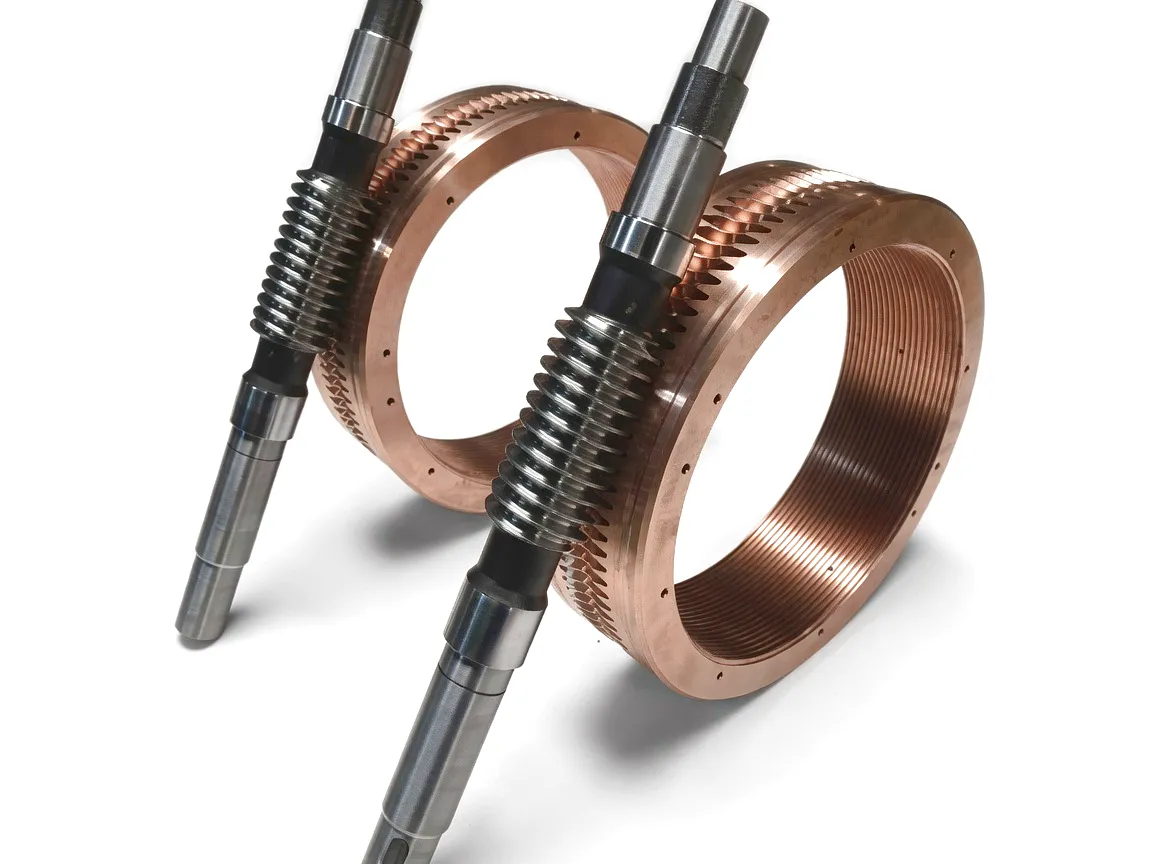
How a Worm Gear Shaft Works: The Engineering Principle
Helical Thread Engagement
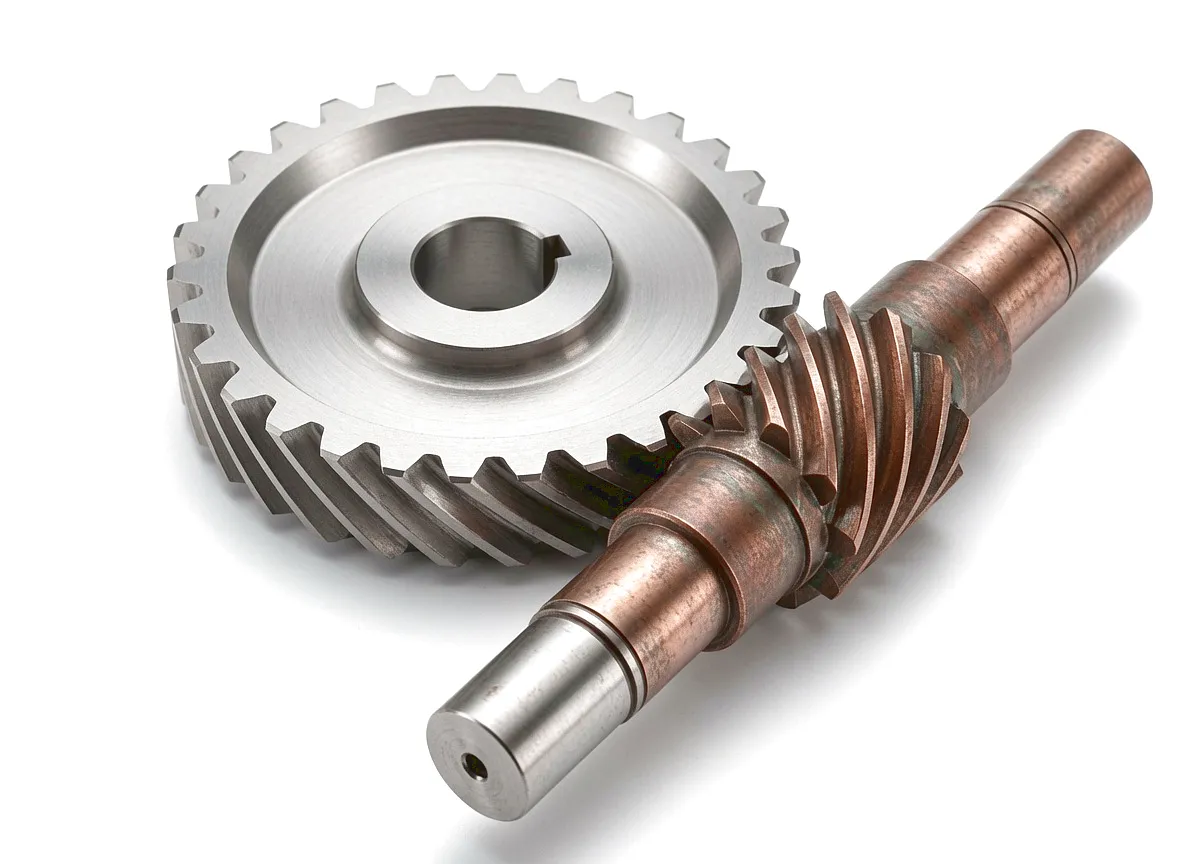
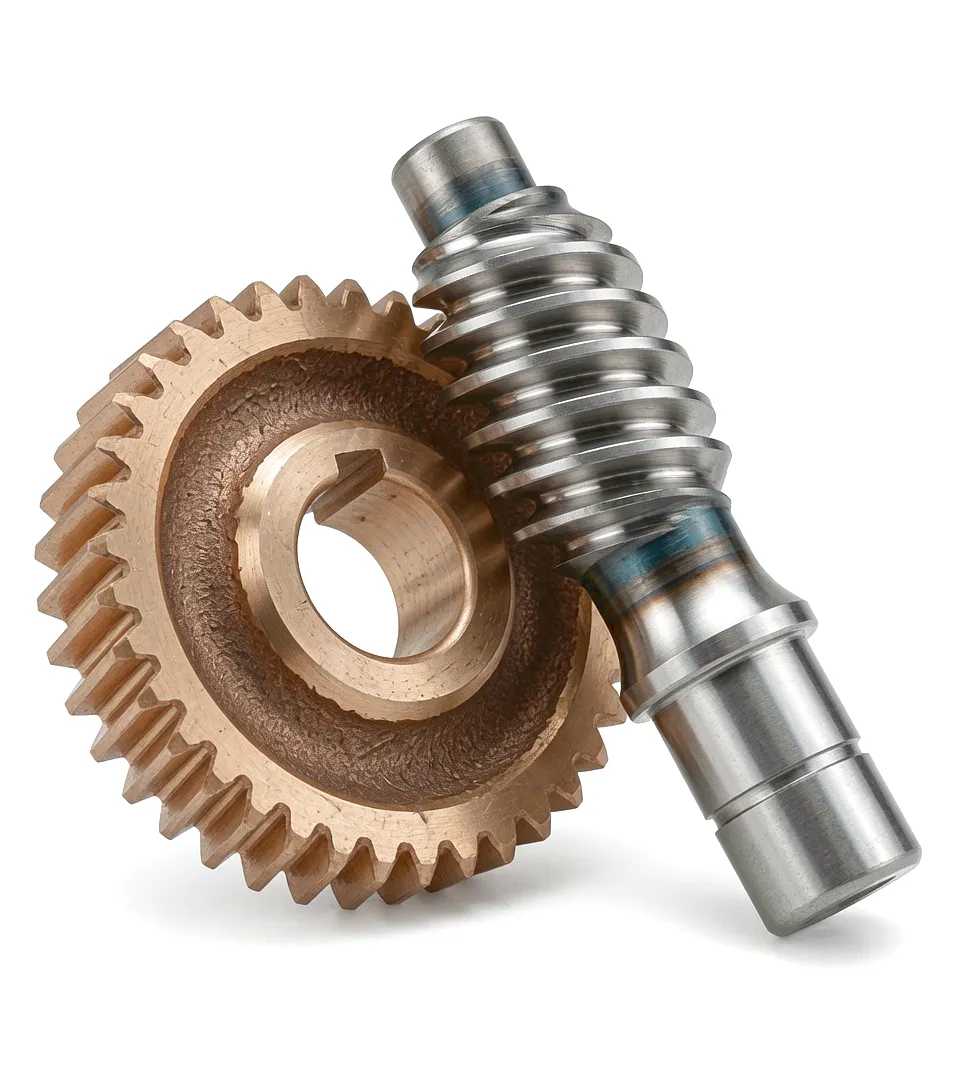
The worm — the driving element — carries one or more helical threads that wrap around the shaft body. As the worm rotates, each thread advances the worm wheel by one tooth per revolution of the shaft. With a single-start worm and a 40-tooth wheel, the output turns 40 times slower than the input, yielding a 40:1 ratio with no intermediate stages. The lead angle of the thread directly governs friction behaviour: shallow lead angles, typically below 6 degrees, generate enough friction in the mesh to prevent back-driving, creating the inherent self-locking characteristic that engineers in British food processing and lifting equipment industries value so highly.
Sliding Contact Mechanics
Unlike spur or helical gears where contact is predominantly rolling, the worm gear shaft engages the wheel through a sliding action across the full tooth face. This sliding motion generates heat that must be managed through lubrication selection — typically ISO VG 220–460 gear oils with extreme-pressure additives for industrial service. The friction inherent in sliding contact does limit mechanical efficiency to 70–95% depending on lead angle and surface finish, which is a factor engineers balance against the self-locking benefit when specifying units for crane mechanisms, conveyor drives, or actuator systems across manufacturing plants in Coventry, Leeds, and Bristol.
Torque Multiplication Effect
Torque multiplication follows from the speed reduction ratio. A 50:1 reduction stage receiving 10 Nm of input torque delivers up to 500 Nm at the output shaft (before deducting friction losses). This dramatic torque amplification in a compact housing explains why worm gear shafts are specified wherever high holding loads must be managed by small motor frames. The pitch cylinder, defined by the shaft diameter and lead, sets the fundamental relationship between tooth load, contact stress, and service life — parameters that Ever Power engineers calculate using advanced FEA simulation before any shaft leaves the production floor.
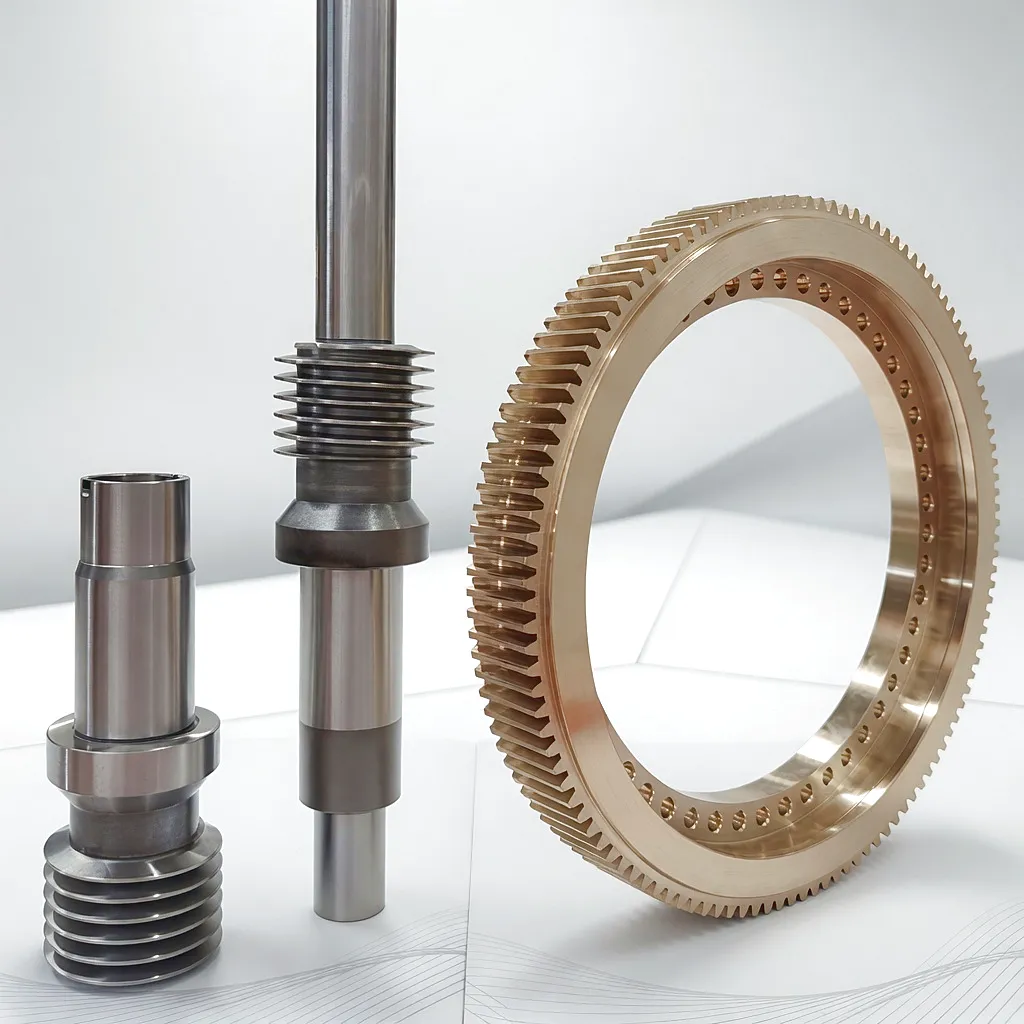
Core Technical Advantages of Worm Gear Shafts
High Reduction Ratios in One Stage
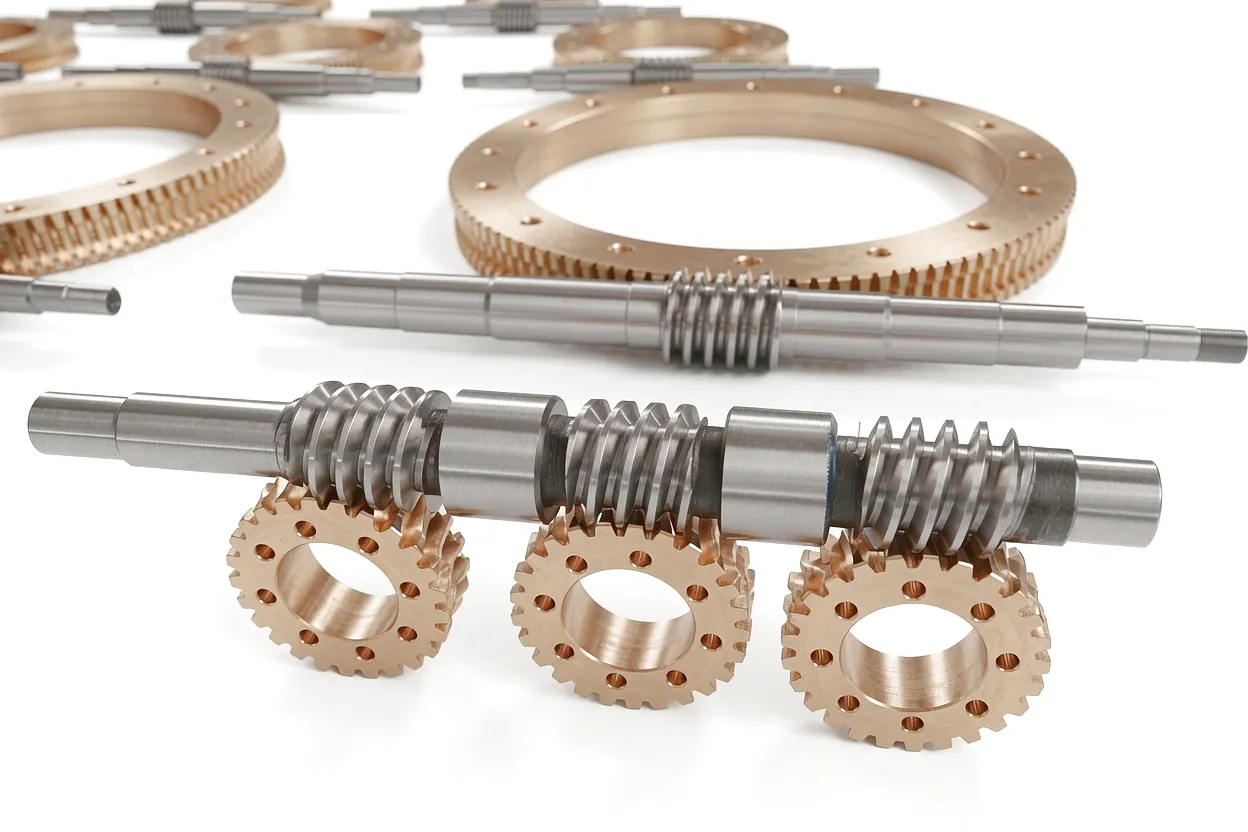
Standard worm gear shaft assemblies achieve ratios from 5:1 to 100:1 in a single mesh stage, eliminating the multiple gear steps required by spur or helical systems. Extended ratios reaching 300:1 or beyond are achievable with compound arrangements, making the worm drive the go-to choice wherever extreme speed reduction within a constrained envelope is required.
Self-Locking Under Load
When the lead angle is below approximately 6 degrees, a worm gear shaft becomes irreversible — the worm wheel cannot drive the worm backwards. This passive braking action removes the need for separate mechanical brake units on hoists, lifts, conveyors, and valve actuators, reducing both the bill of materials and potential failure points in safety-critical installations across British engineering sectors.
Compact, Right-Angle Geometry
The 90-degree shaft arrangement is inherent to the worm gear configuration and requires no additional bevel stages to achieve. For OEM designers building conveyors, mixers, and gantry systems where the drive axis must change direction, this natural geometry simplifies machine frame design, shortens assembly time, and supports more space-efficient plant layouts — a tangible benefit when floor space commands a premium on UK industrial sites.
Smooth, Low-Noise Operation
The sliding mesh engagement and continuous multi-tooth contact produce a notably smooth torque curve with minimal vibration and acoustic signature compared to gear trains with discrete tooth impact events. For applications in packaging, laboratory equipment, and medical device manufacturing — sectors with a strong presence in the Cambridge, Oxford, and London corridors — quiet running is a specification requirement, not merely a preference.
Overload Resilience
The distributed contact area along the worm thread gives the mesh a natural ability to absorb momentary overloads without tooth failure. Combined with the use of bronze worm wheels that deform slightly under overload rather than fracturing, the system provides a mechanical fuse effect that protects motor and load from catastrophic damage — a characteristic valued in intermittent-duty press feed and material handling systems throughout Yorkshire and the East Midlands.
Worm Gear Shaft Technical & Performance Parameters
| Parameter | Standard Range | Ever Power Custom Range | Notes |
|---|---|---|---|
| Shaft Diameter | 16 — 200 mm | 8 — 500 mm | Tolerance h6/h7 standard |
| Output Torque | 5 — 5000 Nm | Up to 50,000 Nm | Peak torque 2.5× rated permissible |
| Reduction Ratio | 5:1 — 100:1 | 5:1 — 300:1 (compound) | Single or double-start worm options |
| Shaft Angle | 90° (standard) | 45° — 90° custom | Non-intersecting axis geometry |
| Shaft Material | 20CrMnTi, 42CrMo4 | 316L SS, 38CrMoAlA, titanium alloy | Per ASTM / DIN / BS EN standards |
| Surface Hardness | HRC 55 — 60 | HRC 58 — 62 (case carburised) | Core toughness HRC 28 — 35 |
| Thread Form | ZA, ZI, ZN, ZK | All forms; custom profile grinding | Per DIN 3975 / ISO 1122 |
| Tooth Accuracy Class | Class 8 — 6 | Class 5 — 4 (precision ground) | Per GB/T 10089 / DIN 3974 |
| Surface Roughness (Ra) | Ra 0.8 — 1.6 µm | Ra 0.2 — 0.4 µm | CNC thread grinding + superfinish |
| Mechanical Efficiency | 70 — 88 % | Up to 95 % (multi-start, optimised) | Increases with number of starts |
| Operating Temperature | −20 — +80 °C | −40 — +150 °C | Dependent on bearing and seal selection |
Industrial Application Scenarios
 Continuous conveyor lines serving automotive assembly plants in Birmingham and Coventry demand gearboxes capable of sustaining constant low-speed torque under heavy belt loading without creep or position drift. Worm gear shafts meet this demand through their self-locking torque retention, which maintains conveyor position precisely during emergency stops. In high-bay automated warehouse facilities across the West Midlands and Greater Manchester, worm drive units control the elevation of storage retrieval platforms, managing payloads exceeding 2,000 kg while drawing minimal power from the building management system.
 The azimuth drive mechanism in solar photovoltaic tracking systems has become one of the most technically demanding applications for worm gear shafts in the renewable energy sector. Single-axis and dual-axis solar trackers require a drive that can hold the panel at a precise angle against wind loading while consuming almost no energy during dwell periods. The worm gear shaft fulfils both requirements simultaneously. With gear ratios typically between 300:1 and 1000:1, these units pair with low-speed motors producing output shaft speeds of just 0.1 to 1 r/min, so that each tracker needs only to rotate approximately 160 degrees across an entire day of solar tracking.

Further Application Sectors
Marine Winch Drives
Agricultural Machinery
Textile Winding
Stage Rigging & Theatre
Water Treatment Weirs
HVAC Damper Actuators
Printing Press Adjustment
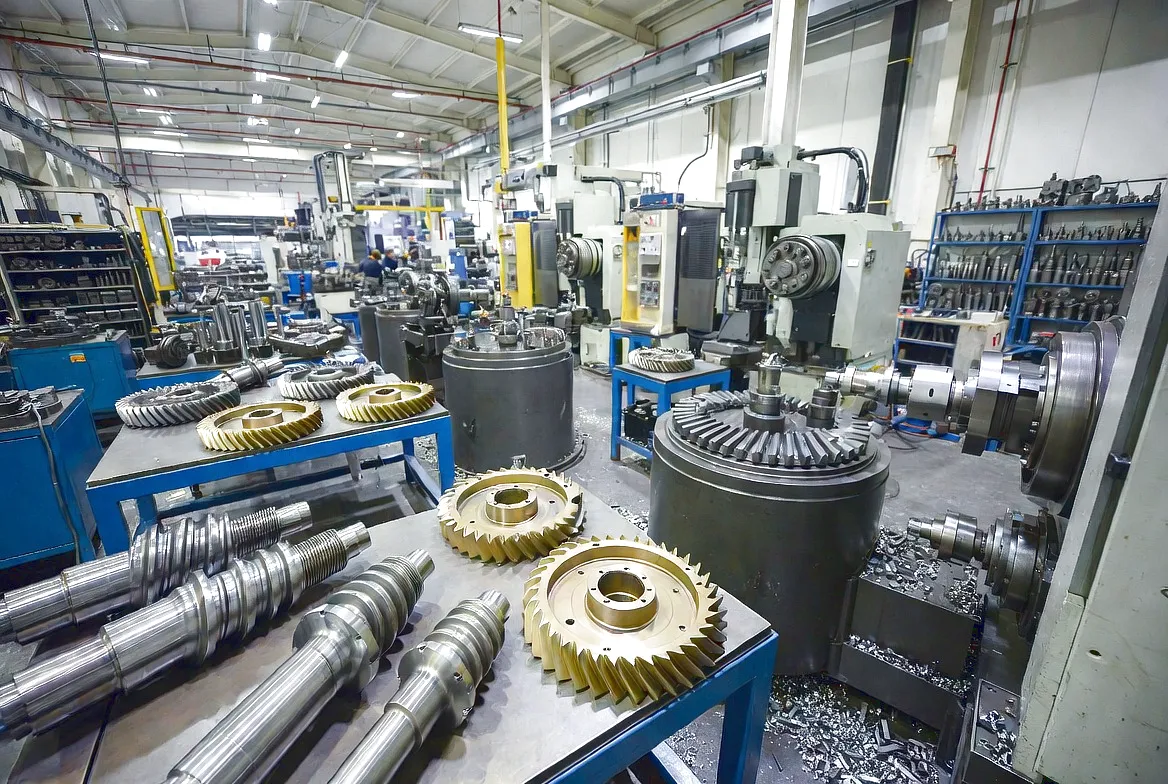
Customer Success Story: Sheffield Hydraulic Cylinder Manufacturer
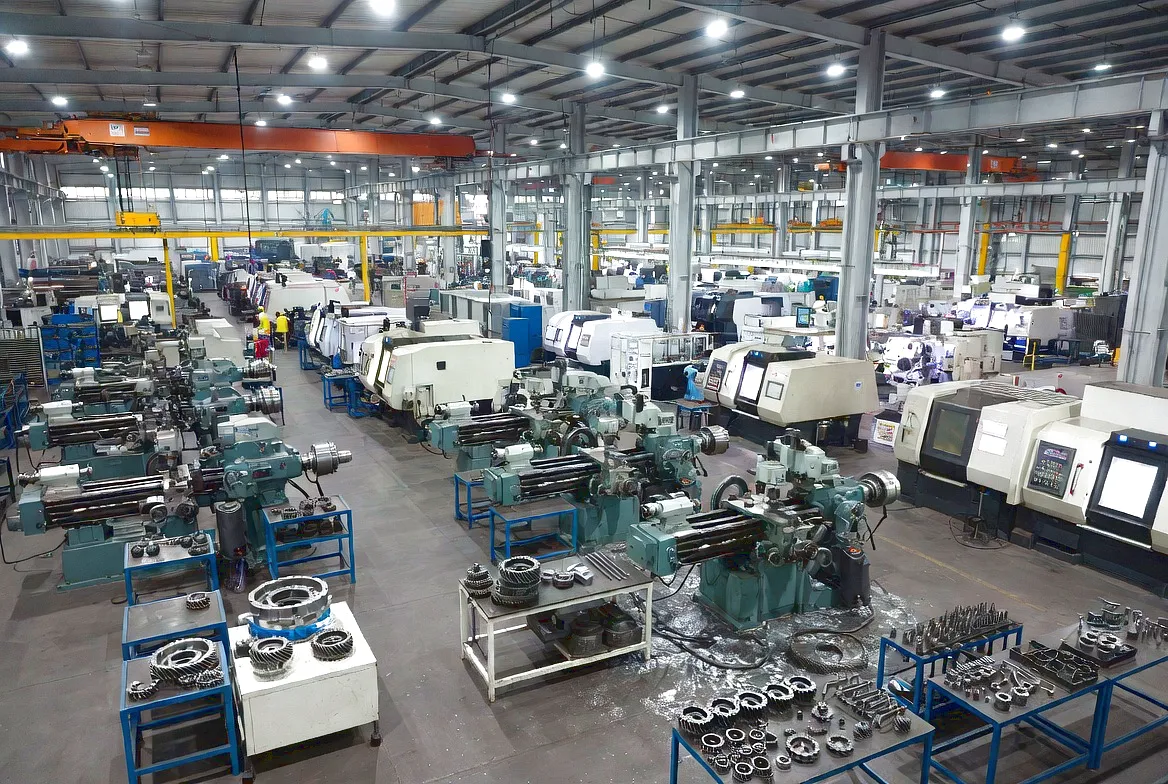
Product Gallery
Frequently Asked Questions
Q
What is the typical price range for a custom worm gear shaft supplied to a UK address, and how do I get a quote from Ever Power?
Pricing for a custom worm gear shaft varies considerably depending on shaft diameter, material grade, accuracy class, heat treatment, and batch quantity. As a general indication, standard catalogue units for common sizes in carbon steel typically range from £45 to £280 per piece in low volumes. Precision-ground stainless steel or carburised alloy steel worm gear shafts produced to customer drawings carry a higher cost reflecting the additional machining and certification involved. To receive a specific quotation for your requirements, please send your drawings or STEP files directly to [email protected] along with material, tolerance, and quantity specifications. Ever Power typically responds with a formal quote within one working day for standard enquiries, with DXF review completed within two working days for complex custom profiles.
Q
How does a worm gear shaft achieve its self-locking property, and which industries in Birmingham and Sheffield rely on this feature most heavily?
The self-locking behaviour of a worm gear shaft arises when the helix lead angle of the worm thread is lower than the friction angle at the contact surface, typically when the lead angle falls below 6 degrees. Under these conditions, the friction force generated by the worm wheel attempting to drive back through the mesh exceeds the driving force available from the output load, meaning the assembly remains stationary without active braking. In Birminghams automotive component manufacturing sector, this property is relied upon to hold transfer press rams in position during die changes. In Sheffield steel and toolmaking industries, self-locking worm gear shafts prevent roll-back in vertical lifting mechanisms and ensure that indexing tables maintain their set positions during machining operations without the need for additional brake units.
Q
Which material is best for a worm gear shaft used in food processing equipment in the UK, and will it comply with FSA hygiene standards?
For food processing environments subject to regular washdown, steam cleaning, or direct contact with food products, grade 316L austenitic stainless steel is the preferred material for a worm gear shaft. This grade provides superior corrosion resistance compared with 304 SS due to its molybdenum content, and it meets the requirements of UK Food Standards Agency guidance on hygiene-critical mechanical components. When combined with a sealed housing and food-grade NSF H1 lubricant — a specification that Ever Power can supply as standard — the complete drive assembly becomes compliant with the hygiene requirements underpinning BRC Global Standard for Food Safety. Ever Power can provide material test certificates (EN 10204 3.1) for all 316L worm gear shaft production batches, supporting quality audit documentation at UK food manufacturing sites.
Q
Where can I find a reliable supplier of worm gear shafts in the UK who can deliver replacement units within a week for emergency breakdown repairs?
For emergency breakdown supply of worm gear shafts within the UK, Ever Power operates a standing stock programme that allows UK-based industrial customers to pre-qualify preferred shaft specifications for priority manufacturing and dispatch. Standard catalogue worm gear shaft sizes are typically available for express European freight dispatch within 3 to 5 working days to any UK mainland destination. For customers with critical plant in areas such as the West Midlands automotive cluster, the Yorkshire heavy engineering belt, or Scotlands offshore supply chain facilities, Ever Power can arrange a framework supply agreement that reserves manufacturing capacity and reduces emergency response time further. Contact [email protected] to discuss standing stock arrangements and emergency despatch terms.
Q
How do I calculate the correct worm gear shaft reduction ratio needed for a solar tracker azimuth drive operating at a specific site wind loading?
Calculating the required reduction ratio for a solar tracker azimuth drive begins with defining the required output shaft angular velocity — typically expressed as degrees of rotation per hour based on solar movement of approximately 15 degrees per hour on the azimuth axis. Dividing the motors minimum stable operating speed in r/min by the required output speed gives a baseline ratio. For wind load self-locking, the worm lead angle must then be checked against the friction coefficient of the worm gear shaft mesh — a lower lead angle increases self-locking capability but reduces efficiency. For UK coastal sites experiencing sustained winds above 12 m/s, a lead angle below 5 degrees with a ratio of at least 300:1 is generally recommended. Ever Powers application engineering team can perform this calculation for your specific motor, site wind load, and panel moment arm dimensions at no charge as part of the enquiry process — contact [email protected] with your project parameters.
Q
What is the expected service life of a worm gear shaft in a continuous-duty industrial conveyor application, and what maintenance does it require?
A properly specified and lubricated worm gear shaft in continuous-duty conveyor service can reasonably be expected to achieve 20,000 to 40,000 operating hours before requiring replacement, depending on speed, torque, ambient temperature, and lubrication regime. The worm shaft itself — being the harder steel element — typically outlasts two or three bronze worm wheel replacements over its service lifetime. Recommended maintenance for conveyor-mounted units includes an oil change at 2,000 to 3,000 hours using an ISO VG 220 or 320 gear oil with EP additives, periodic inspection of shaft seal integrity to prevent oil loss and ingress of abrasive dust, and vibration monitoring to detect bearing deterioration before it propagates to the gear mesh. Ever Power supplies complete documentation packages including lubrication schedules and condition monitoring guidelines with all worm gear shaft orders destined for continuous industrial service.
edit by gzl