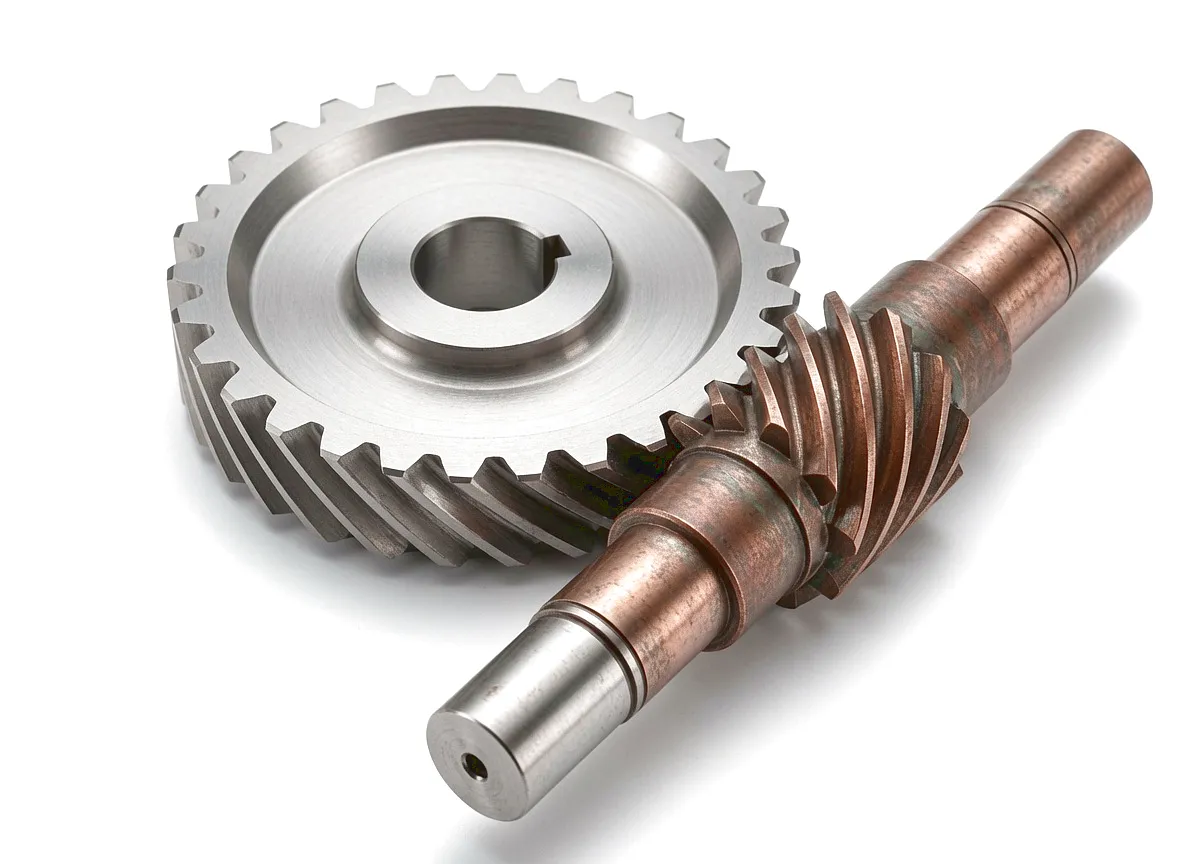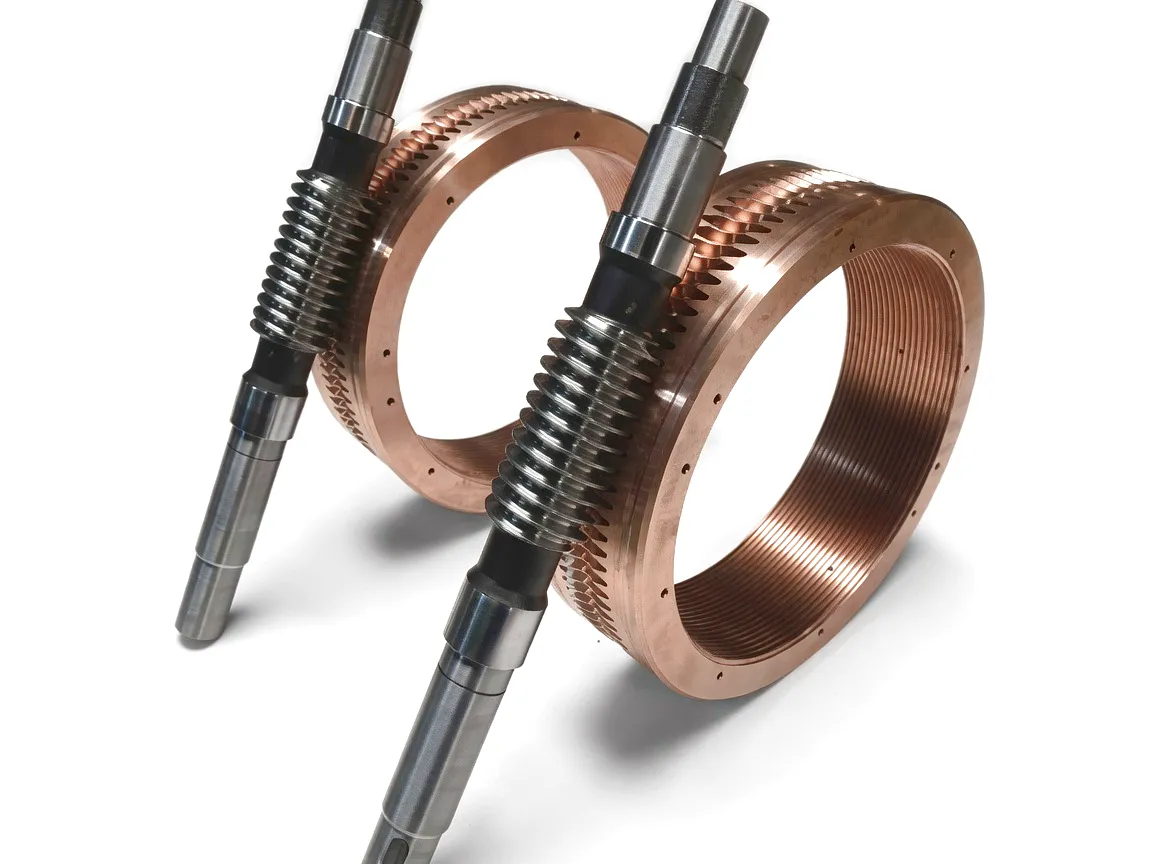
In the world of bulk material handling, the bucket elevator stands as one of the most vital pieces of machinery found across the UK’s grain processing, chemical, mining, and fertiliser sectors. Whether moving tonnes of wheat through a Birmingham flour mill or elevating mineral ore at a Sheffield processing plant, these machines must operate continuously, reliably, and safely around the clock. At the mechanical heart of every high-performance bucket elevator lies a precision-engineered worm gear shaft — a component that governs not just the speed and torque of the drive head, but the fundamental safety of the entire vertical conveying system.
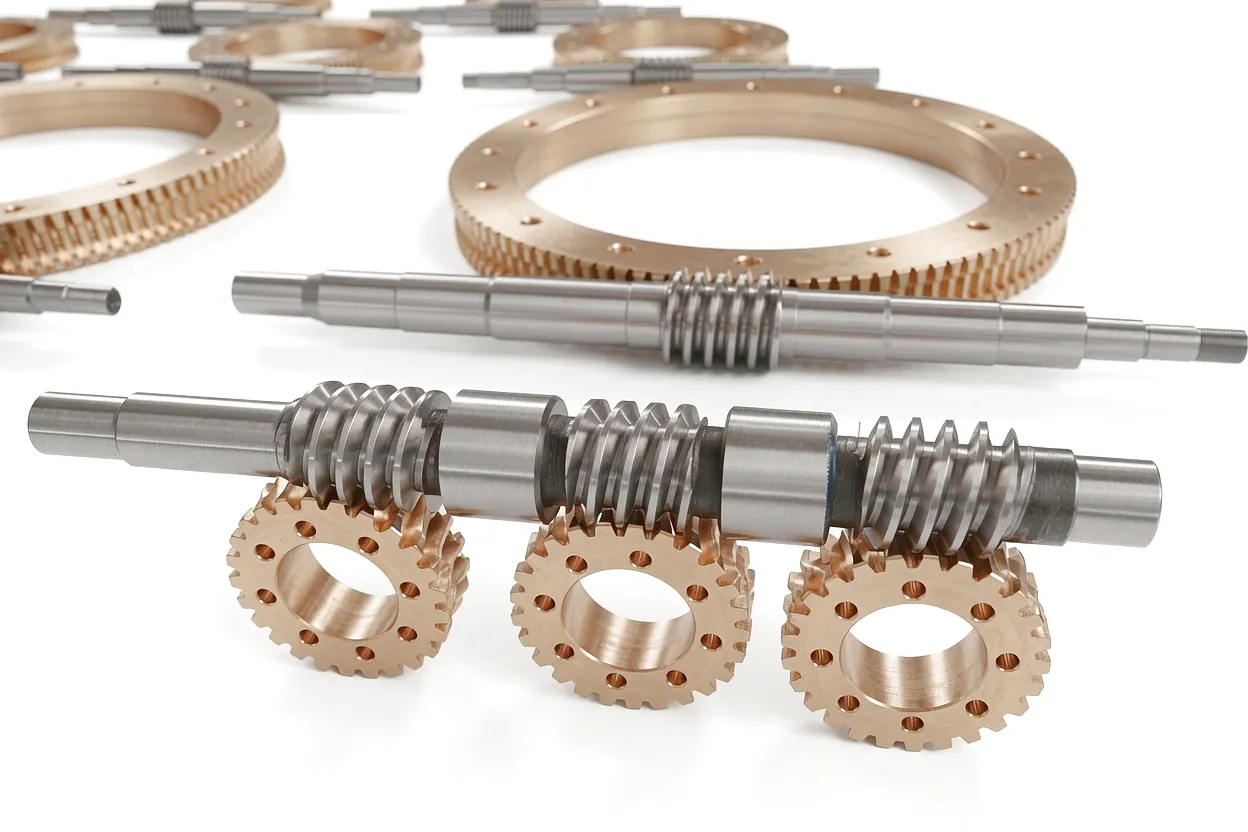
The worm gear shaft is the rotating male element of a worm gear reducer — a helically threaded shaft that meshes with a corresponding worm wheel to transmit motion through a perpendicular axis. In bucket elevator applications, this arrangement is particularly advantageous because of the combination of high reduction ratios, compact geometry, and inherent self-locking behaviour that eliminates the risk of reverse rotation under load. When a bucket elevator carries a full load of grain or fertiliser to a height of 30 to 50 metres and the drive motor is cut, the worm gear shaft’s self-locking characteristics prevent the buckets from sliding back down — no separate backstop mechanism or hydraulic brake required.
How the Worm Gear Shaft Works in a Bucket Elevator Drive Head
The operating principle of a worm gear shaft begins with rotation from the motor shaft, which drives the worm (the shaft itself) at a relatively high speed. The threads of the worm engage progressively and continuously with the teeth of the worm wheel, producing a smooth, stepless speed reduction. Depending on the number of thread starts on the worm gear shaft and the number of teeth on the wheel, gear ratios from 5:1 up to 100:1 and beyond are achievable in a single stage — something no parallel-axis helical gearbox can match without multiple reduction stages.
For a typical UK grain elevator running at a bucket chain speed of 1.2 m/s and a drive sprocket pitch circle diameter of 400 mm, the required output shaft speed is roughly 57 RPM. With a standard 1450 RPM motor, a single-stage worm gear reducer with a reduction ratio of 25:1 delivers exactly that — with a single, compact gearbox occupying minimal space in the drive head assembly. The thermal and load calculations involved in sizing the worm gear shaft for such an application must account for the cyclic starting torque, which can be two to three times the full-load torque at each startup.
The self-locking mechanism is perhaps the most critical behaviour in an elevator context. When the lead angle of the worm thread is less than the friction angle between the mating surfaces — typically when lead angles fall below 5 degrees — the gear set becomes inherently self-locking. This means that even with zero motor torque, the load from the fully-laden bucket chain cannot drive the worm wheel backwards into the shaft. In practical terms, this replaces the mechanical backstop or hydraulic retarder that older elevator designs required, simplifying the overall system architecture and reducing maintenance overhead.
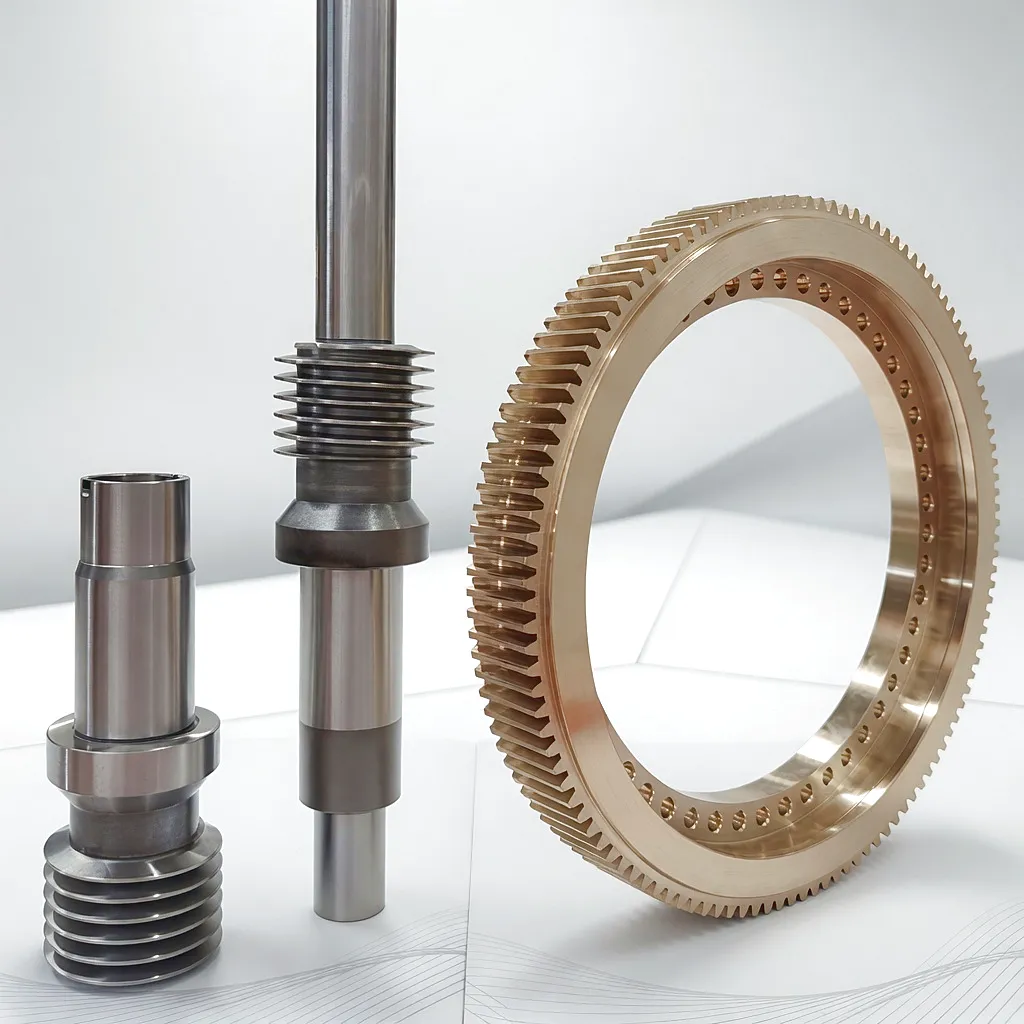
Max Single-Stage
Reduction Ratio
Core Materials Used in Precision Worm Gear Shaft Manufacturing
20CrMnTi, 20CrMnMo, and 40Cr are the go-to shaft steels for high-load applications. These alloys are carburised to surface hardnesses of HRC 58–62 while maintaining a tough, ductile core that absorbs cyclic shock loads. Case depths of 0.8–1.5 mm are standard in bucket elevator drives handling capacities above 50 t/h.
45# and 42CrMo4 steels treated by induction hardening offer a cost-effective alternative for medium-load shafts. Surface hardness reaches HRC 48–55, and the process gives precise control over hardened zone geometry — particularly useful when journal and thread hardness profiles differ by design requirement.
Selected for food-grade elevator applications — common in UK grain processing facilities in the East Midlands and agricultural belt — stainless steel shafts resist corrosion from moisture and cleaning agents while meeting FSMA and UK Food Safety Act traceability requirements. Hardness is lower (HRB 80–95), so load ratings must be derated accordingly.
While the shaft is steel, the mating worm wheel is almost universally cast or centrifugally cast phosphor bronze (CuSn10P or CuSn12). Its low friction coefficient against hardened steel, excellent run-in behaviour, and resistance to galling make it the pairing of choice for worm drive assemblies operating in the demanding duty cycles of continuous elevator service.
Beyond base metallurgy, surface treatments including shot peening, phosphate coating, and precision grinding to DIN 3974 accuracy grades (typically Grade 6 or Grade 7 for elevator service) define the final performance envelope of each worm gear shaft. Thread profile accuracy — particularly tooth lead angle and normal pitch — is measured to tolerances finer than 0.01 mm, directly influencing the efficiency, noise signature, and service life of the assembled gearbox in the field.
Core Technical Advantages of the Worm Gear Shaft in Elevator Drive Systems
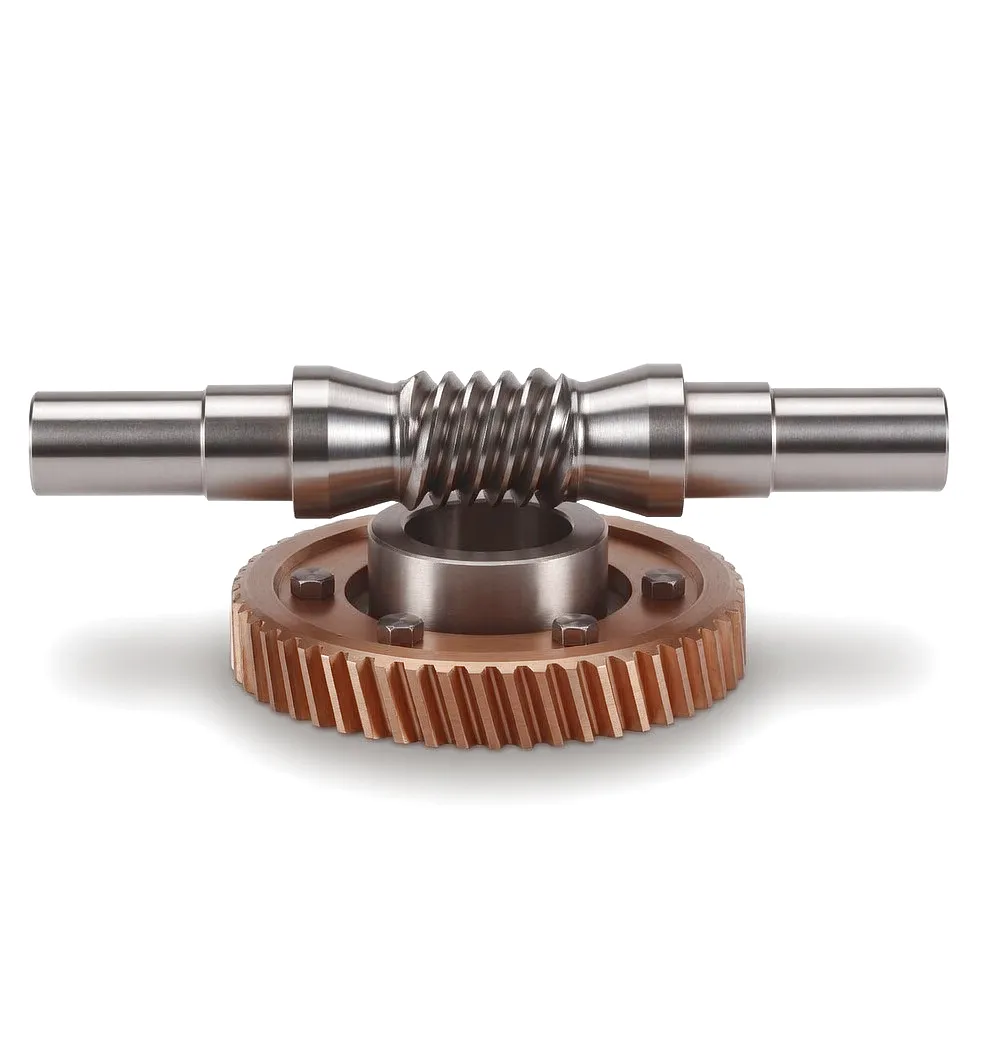
The engineering case for choosing a worm gear shaft-based reducer in bucket elevator applications is compelling on multiple fronts. The geometry of the worm drive enables a set of performance characteristics that alternative gear types — including helical bevel or planetary reducers — cannot match simultaneously, and this combination makes the worm gearbox the dominant choice in vertical conveying across UK processing industries.
Compact output shaft torque density is the standout characteristic. A 90-frame worm gearbox with a 40:1 ratio can deliver output torques exceeding 800 Nm in a package that fits within a 250 mm cube — far smaller than the equivalent helical reducer. This compactness is critical in the confined drive head enclosures of tall bucket elevators where space is at a premium and access for maintenance must be factored into every millimetre of the design envelope.
Thread lead angles below the friction threshold make reverse driving mechanically impossible without auxiliary input. Eliminates the need for separate mechanical backstops or ratchet mechanisms, reducing component count and maintenance touchpoints.
Ratios from 5:1 to 100:1 achievable in one gear mesh. This eliminates secondary gear trains in typical elevator drive applications, saving cost, weight, and gearbox footprint while reducing transmission noise significantly.
The continuous line contact between worm thread and wheel teeth produces inherently smooth torque transmission with minimal vibration. In food-grade or pharmaceutical elevator installations — typical in UK’s Yorkshire and Lincolnshire agri-processing zones — this low-noise operation is not just preferred, it is often a site compliance requirement.
The 90-degree offset between input and output shafts suits the spatial constraints of bucket elevator head stations, where the drive motor aligns horizontally along the building platform while the drive sprocket shaft runs transversely across the elevator casing.
At the 40–80 RPM output speeds typical of elevator bucket chain drives, worm gear shafts exhibit exceptionally low vibration compared to bevel or spur gear alternatives. This extends the service life of the bucket chain, sprockets, and the structural elements of the elevator casing itself.
When properly specified, lubricated, and maintained, a quality worm gear shaft and wheel set in a grain elevator service environment can deliver 50,000 to 80,000 hours of operational life — reducing the total cost of ownership significantly against frequent replacements with lower-specification alternatives.
Product Technical & Performance Parameter Table
The following table consolidates the key technical parameters applicable to worm gear shafts used in bucket elevator drive assemblies. These values reflect the standard performance envelope of Ever Power’s precision-manufactured shafts for UK and international industrial customers, and should be used as a reference baseline when specifying or comparing gear reducer components.
| Parameter | Standard Range | Customisable Range | Notes |
|---|---|---|---|
| Shaft Material | 20CrMnTi, 40Cr, 45# Steel | 316L SS, 42CrMo4, Alloy Custom | Food/chemical grade on request |
| Surface Hardness | HRC 48–55 (induction) | HRC 58–62 (carburised) | Case depth 0.8–1.5 mm standard |
| Gear Ratio (Single Stage) | 5:1 – 60:1 | Up to 100:1 | 20:1–50:1 typical for elevators |
| Output Torque | 50 – 4,000 Nm | Up to 15,000 Nm | Per AGMA 6034-B92 |
| Input Speed (Motor RPM) | 750 – 1500 RPM | Up to 3000 RPM | 1450 RPM is standard UK 4-pole |
| Output Speed Range | 14 – 280 RPM | Per ratio specification | 40–70 RPM typical elevator |
| Mechanical Efficiency | 70 – 92% | Ratio-dependent | Higher at lower ratios |
| Shaft Crossing Angle | 90 degrees | Non-standard on request | Right-angle standard configuration |
| Accuracy Grade (Thread) | DIN 3974 Grade 7 | Grade 5–6 precision | For high-precision servo applications |
| Operating Temperature | -20 °C to +90 °C | Up to +120 °C | Synthetic lubricant required above 90 °C |
| Chain Speed (Bucket) | 1.0 – 2.0 m/s | Application-specific | Optimal for grain / mineral duty |
| Service Life (Target) | 50,000 hours min | Up to 80,000 hours | With scheduled lubrication maintenance |
Industrial Application Scenarios Across UK Manufacturing Sectors
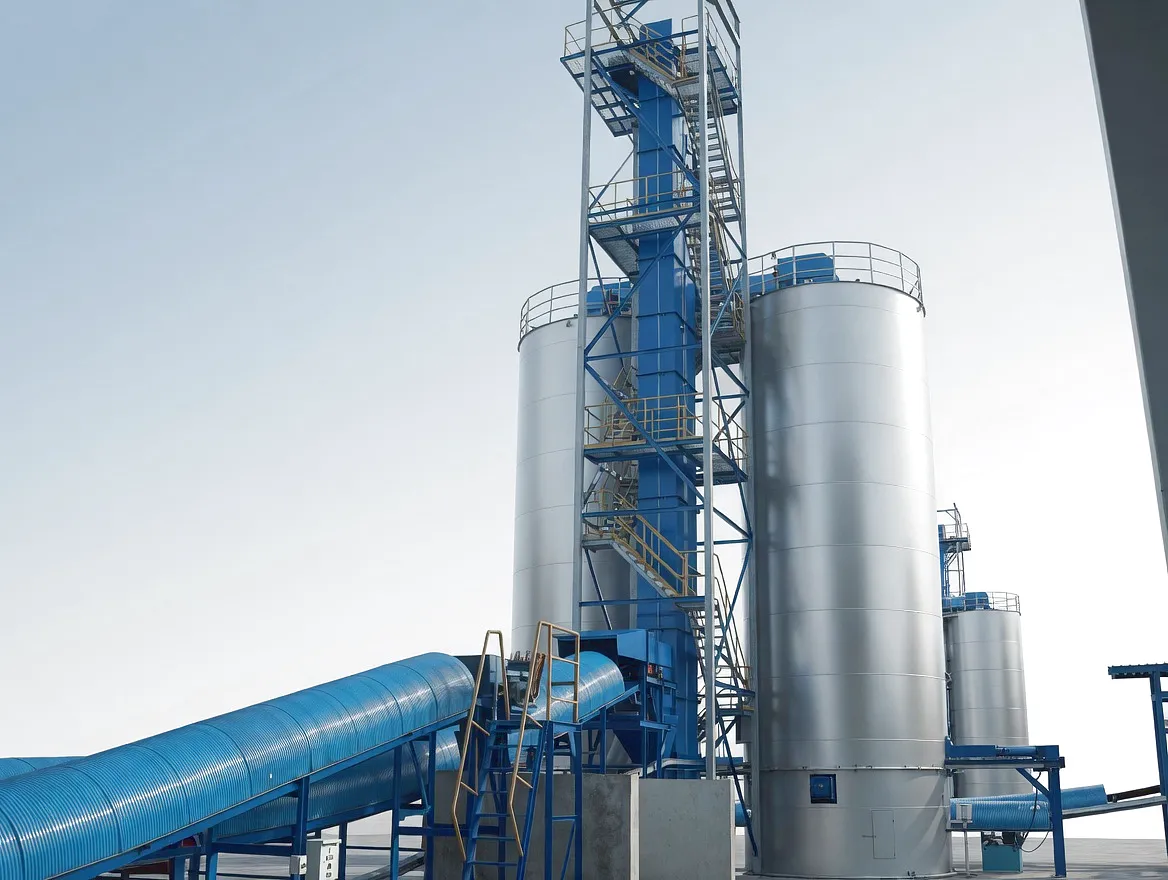
Grain and agricultural processing facilities represent the single largest user segment for worm gear shaft-equipped bucket elevators across the UK. Operations centred in the East Midlands, Lincolnshire, and East Anglia — England’s primary grain production regions — rely on bucket elevators to move wheat, barley, rapeseed, and maize from ground-level intake pits to elevated storage bins, often at heights of 20 to 40 metres. The worm gear shaft’s self-locking characteristic is essential here: when a loaded elevator stops unexpectedly mid-cycle, the contents of the buckets must remain stationary without any reverse creep. Grain that migrates back through the intake zone creates bridging, contamination, and potentially dangerous pressure build-up against intake valves.
Throughput requirements in UK grain stores typically range from 60 to 250 tonnes per hour, and the worm gear shaft assemblies used in these applications are specified for continuous duty service — often operating 18 hours a day during the August to October harvest window. Shaft bore diameters of 50 to 90 mm are common at this scale, with gear ratios of 25:1 to 40:1 matched to 11 to 37 kW drive motors.
Major fertiliser blending and bagging operations across Teesside and the Humber estuary depend on bucket elevators to handle ammonium nitrate, NPK blends, and potash. The worm gear shaft in these environments must tolerate a chemically aggressive atmosphere while the self-locking property ensures ATEX-compliant safe shutdown without relying on additional braking systems in potentially explosive dust atmospheres.
Sheffield’s historically strong metals and engineering sector continues to utilise bucket elevators for handling iron ore fines, slag, scale, and refractory powders. Worm gear shafts specified for these heavy-duty applications typically feature 42CrMo4 alloy steel with induction-hardened threads and rated output torques above 2,000 Nm to handle the high bulk densities — iron ore fines alone weigh 2,500 to 3,000 kg/m3 — that steel processing materials present.
Cement clinker, limestone, and gypsum elevators operating at UK cement plants — including facilities in the Peak District and Yorkshire — demand worm gear shafts capable of handling abrasive dust-laden environments over decade-long service intervals. Sealed bearing housings and IP65-rated gearbox enclosures are standard specifications, with synthetic oil fill for extended change intervals.
Animal feed mills and pet food manufacturing plants, heavily concentrated in the West Midlands and along the M1/M6 corridor, use worm gear shaft reducers in bucket elevator systems elevating pelletised feed, biscuit meal, and dried ingredients. Stainless steel shaft variants and food-grade NSF H1 lubricant compatibility are prerequisite specifications for this sector.
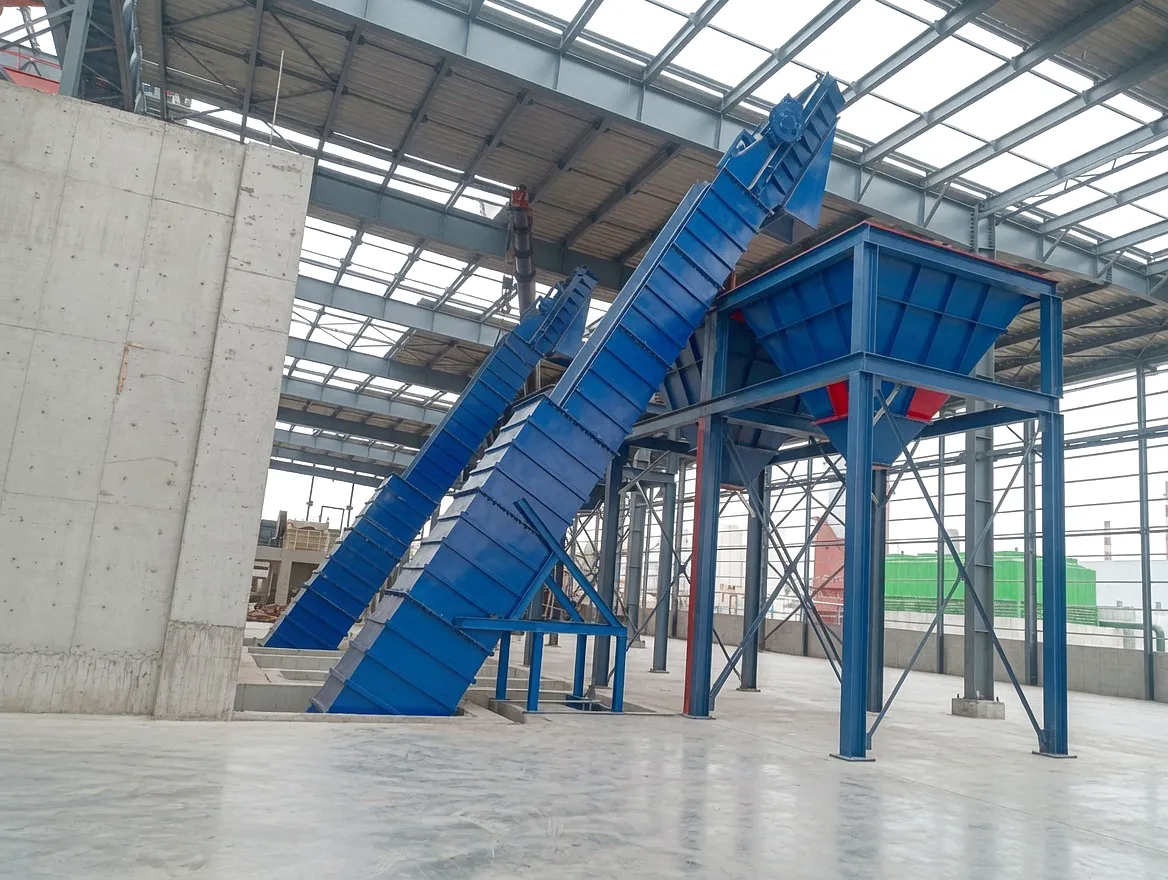
In the coal fines handling and aggregates processing sectors — operations still active in South Yorkshire, Nottinghamshire, and parts of Wales — worm gear shaft assemblies encounter the most punishing duty cycles: high starting frequency, continuous operation in ambient temperatures ranging from near-freezing in outdoor structures to over 40 degrees Celsius near drying equipment. Specifying the correct shaft material grade, bearing type, and seal specification for these ranges is a critical engineering decision that directly determines plant availability and maintenance costs over the long term.
Ever Power: Precision Worm Gear Shaft Manufacturing & Custom Engineering
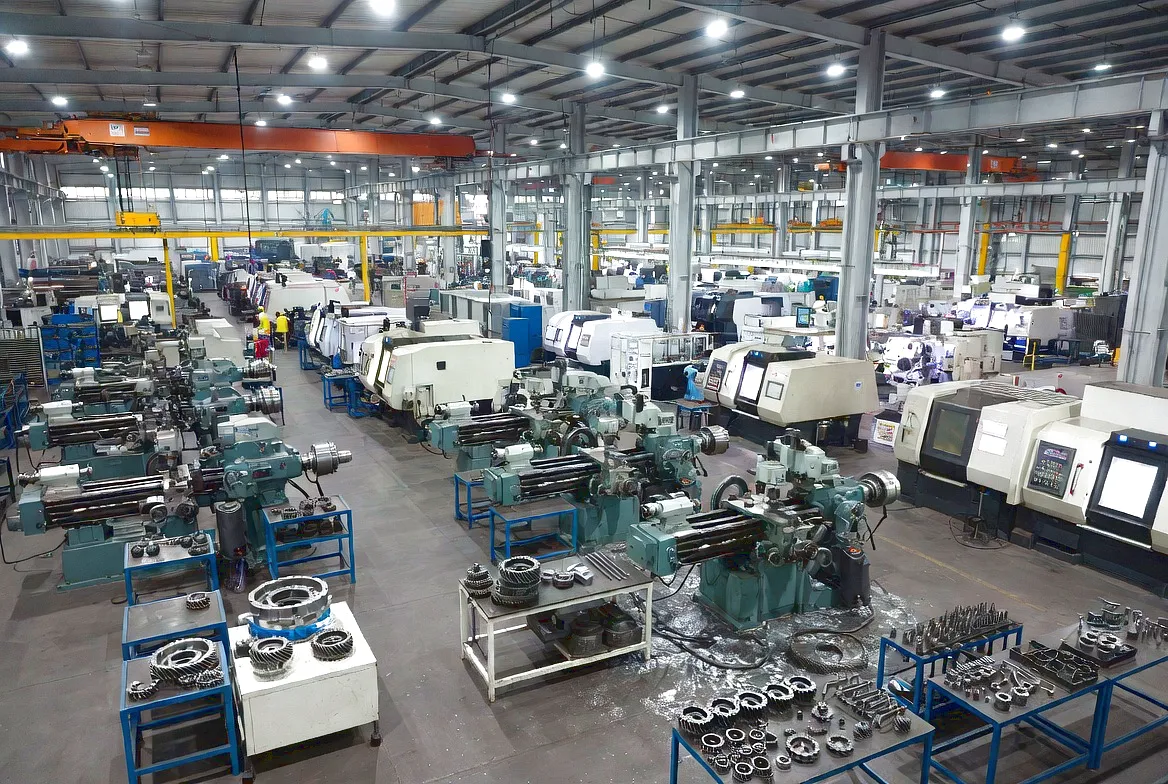
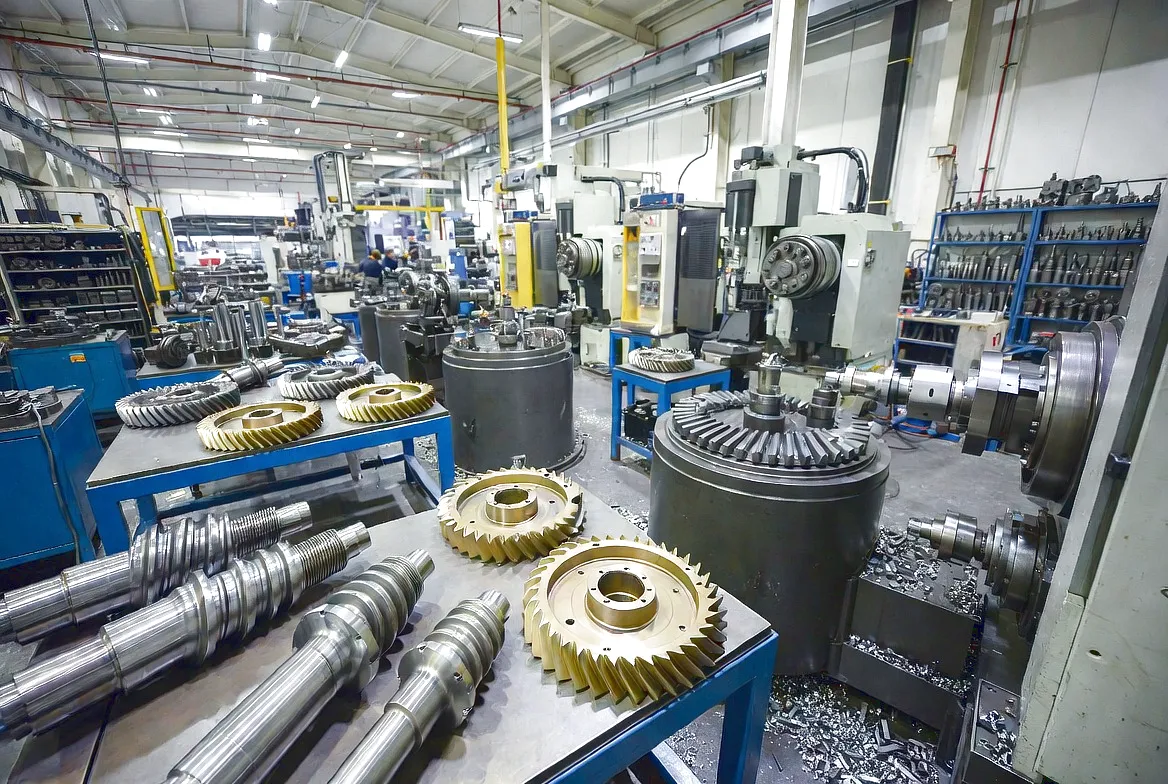
Ever Power operates a dedicated precision worm gear shaft manufacturing division equipped with CNC thread grinding centres, multi-axis turning and milling machining cells, carburising and induction hardening heat treatment lines, and CMM coordinate measuring rooms for 100% dimensional inspection. Every worm gear shaft that leaves the Ever Power facility carries a full material traceability certificate — including mill test reports for raw steel, heat treatment furnace logs, and CMM measurement records — meeting the documentation requirements of UK customers operating under ISO 9001:2015 quality management systems and sector-specific accreditations.
Where off-the-shelf shaft profiles are insufficient for the application — and in demanding bucket elevator engineering this is the norm rather than the exception — Ever Power’s engineering team works directly with UK plant engineers and procurement specialists to develop bespoke shaft solutions from the ground up. This customisation capability extends to shaft diameter, keyway and spline profile, thread module and lead angle, bearing journal dimensions, journal runout tolerances, surface finish class, and material specification. Lead times for custom worm gear shafts are typically 15 to 25 working days for new design iterations, with established recurring designs fulfilled within 8 to 12 working days and stocked at Ever Power’s logistics hub for expedited delivery to UK customers requiring next-day or two-day despatch.
Lubrication Strategy and Maintenance Intervals for Worm Gear Shaft Assemblies
 The efficiency and longevity of a worm gear shaft are more sensitive to lubrication quality and quantity than almost any other transmission element. The sliding contact that defines the worm gear mesh — different in kind from the predominantly rolling contact of helical or bevel gears — generates proportionally more heat and requires a lubricant film with high film strength, strong adhesion to gear surfaces, and good thermal stability. In bucket elevator service, where the gearbox may run continuously for 16 hours at a stretch during UK harvest season operations, the thermal load on the lubricant is substantial and must be accounted for in the oil fill specification.
ISO VG 220 or VG 320 worm gear oil — either mineral type with extreme pressure (EP) additives or fully synthetic PAO-based — is the standard recommendation for bucket elevator worm gear shafts operating in the 50 to 90 RPM output speed range. Synthetic oils offer a clear advantage in extended oil change intervals: where mineral-based oils in a continuous-duty elevator application require changes every 2,000 to 3,000 operating hours, synthetic fill can extend this interval to 8,000 to 10,000 hours, reducing maintenance downtime and oil disposal costs across a multi-elevator facility.
Oil fill level should be verified monthly during the first three months of new gearbox service, as the initial run-in period causes minor temperature cycling that can affect seal performance and oil level. Bearing vibration monitoring via hand-held analyser or permanent sensor at the gearbox input bearing housing should be incorporated into any planned maintenance programme, with alert thresholds set at 1.5 times the baseline RMS vibration reading. Experienced UK maintenance teams at grain and mineral processing sites have found that early detection of rising vibration — typically indicating bearing wear or thread flank pitting — allows proactive shaft replacement during planned maintenance windows, avoiding unplanned downtime during peak operational periods.
How a Sheffield Industrial Minerals Processor Eliminated Unplanned Elevator Downtime
 A mid-sized industrial minerals processing company operating three bucket elevator lines at their Sheffield facility contacted Ever Power in early 2024 following a series of costly unplanned stoppages attributed to wear failures in their existing worm gear reducer shafts. Their elevators — handling calcium carbonate and kaolin powders at throughputs of 80 to 120 tonnes per hour — had been running on a competing brand of worm gear shaft that showed premature thread flank spalling within 18 to 24 months of service, well short of the 40,000-hour target life specified in their original equipment documentation. The unexpected downtime was costing the company an estimated £8,000 to £14,000 per stoppage event in lost production, emergency labour, and logistics disruption on committed customer orders.
Ever Power’s engineering team conducted a root cause analysis drawing on the failed shaft samples and the customer’s operating data. The investigation identified two contributing factors: the original shafts had been manufactured from a lower-grade 45# steel with surface hardness only reaching HRC 46 — below the HRC 52 minimum that the application’s specific lead angle and contact stress geometry required — and the initial lubricant fill had been ISO VG 150, too low a viscosity for the gearbox’s operating sump temperature of approximately 72 degrees Celsius under full load.
Ever Power supplied replacement worm gear shafts manufactured from 20CrMnTi case-hardened alloy steel, carburised to a case depth of 1.2 mm and ground to DIN 3974 Grade 6 accuracy across all three elevator drive units. The customer’s lubricant was upgraded to a fully synthetic ISO VG 220 PAO worm gear oil. A set of replacement phosphor bronze worm wheels — also precision manufactured by Ever Power — was supplied for the most heavily worn unit, while the two less-worn units retained their original wheels after inspection confirmed acceptable tooth geometry.
At the 24-month review following installation, all three elevator drives were running within specification with no thread wear measurable beyond DIN 3974 tolerance limits. The Sheffield facility recorded zero unplanned elevator stoppages attributable to gear drive failures in that period — a result that the plant engineering manager described as a straightforward return on investment, achieved simply by selecting the right shaft specification and lubricant for the actual operating conditions rather than the nominal catalogue rating.
“We had been losing roughly two full production days a year to gear reducer failures on our grain elevator at our Lincolnshire site. After switching to Ever Power’s case-hardened worm gear shafts we’ve now run 26 consecutive months without a single gearbox-related stoppage. The improvement in reliability is measurable and the cost saving is real.”
“The customisation capability from Ever Power is what sets them apart. Our elevator head configuration requires a non-standard shaft keyway position and a specific journal diameter to match our bearing housing — Ever Power delivered exactly to our drawing on the first attempt, with full CMM reports included. Lead time was 14 working days, which worked perfectly with our planned shutdown schedule.”
“We sourced five worm gear shaft assemblies from Ever Power for our fertiliser blending elevator refurbishment at our Teesside plant. The material certs and heat treatment documentation were ready before we even asked for them, which made the ATEX compliance audit straightforward. Performance after 14 months of continuous service shows no measurable wear and the gearbox sump temperature runs 8 degrees cooler than the units we replaced.”
How to Select the Right Worm Gear Shaft for Your Bucket Elevator Application
Selecting a worm gear shaft for a specific bucket elevator installation is not a catalogued exercise — it requires a structured engineering calculation that begins with the conveying duty and works backwards through the drive train to the shaft specification. The key inputs are: the material bulk density (kg/m3), the volumetric throughput (m3/h), the bucket chain speed (m/s), the required elevation height (m), the drive motor speed (RPM), and the duty cycle classification (continuous, intermittent, or cyclic). From these, the required output torque is calculated — accounting for the efficiency of the worm gear shaft itself at the proposed ratio — and the service factor is applied based on the number of daily start cycles and the load shock characteristic of the material.
For grain elevators at standard UK installation heights of 25 to 35 metres, 11 kW to 22 kW motors with gear ratios of 25:1 to 40:1 are typical, yielding output torques of 900 to 2,800 Nm at the drive shaft. For mineral and cement elevators at 40 to 50 metres, motor powers of 30 to 75 kW are common, with output torques extending to 6,000 Nm or above. Bearing selection for the worm gear shaft must account for the radial overhang from the drive sprocket — which generates a significant bending moment on the output shaft journal — alongside the axial thrust that the helical worm thread inherently generates and that must be absorbed by either tapered roller or angular contact bearings at the input shaft housing.
| Application Type | Motor Power (kW) | Gear Ratio | Output Torque (Nm) | Recommended Shaft Steel |
|---|---|---|---|---|
| Grain / Seed (Light) | 7.5 – 15 | 25:1 – 30:1 | 900 – 1,600 | 45# Induction / 20CrMnTi |
| Grain / Fertiliser (Med.) | 18.5 – 30 | 30:1 – 40:1 | 1,800 – 3,200 | 20CrMnTi Carburised |
| Mineral / Ore (Heavy) | 37 – 75 | 40:1 – 60:1 | 3,500 – 7,000 | 42CrMo4 Induction / Carb. |
| Cement / Clinker (V. Heavy) | 55 – 110 | 40:1 – 80:1 | 5,000 – 15,000 | 42CrMo4 Carburised + Ground |
| Food / Pharma (SS Grade) | 5.5 – 22 | 20:1 – 40:1 | 600 – 2,000 | 316L Stainless (Derated) |
Frequently Asked Questions
Send your drawings, OEM reference, or application data to the Ever Power engineering team. Quotations, technical reviews, and material certification packages available within one working day.