Ever Power | Precision Mechanical Transmission
Worm Gear Shafts: Comprehensive Engineering Guide to Design, Selection, and Industrial Applications
From escalator drive systems and conveyor networks to heavy-duty manufacturing lines across Birmingham and Sheffield — everything you need to know about specifying, sourcing, and optimising the worm gear shaft for your operation.
When engineers across the UK’s manufacturing heartland — from the steel foundries of Sheffield to the precision machining centres of Birmingham — reach for a power-transmission solution that delivers compact torque multiplication with guaranteed self-locking capability, the worm gear shaft sits at the top of the shortlist. It is the workhorse behind escalator drive stations in the London Underground, the backbone of automated conveyor systems at distribution warehouses in the West Midlands, and the enabling technology in wind-turbine yaw drives scattered across Scotland’s renewable-energy corridor. Understanding this component in full — its geometry, its materials, its load ratings, and its failure modes — is no longer optional for any engineer or procurement specialist who expects long operational life and low total cost of ownership from their rotating equipment.
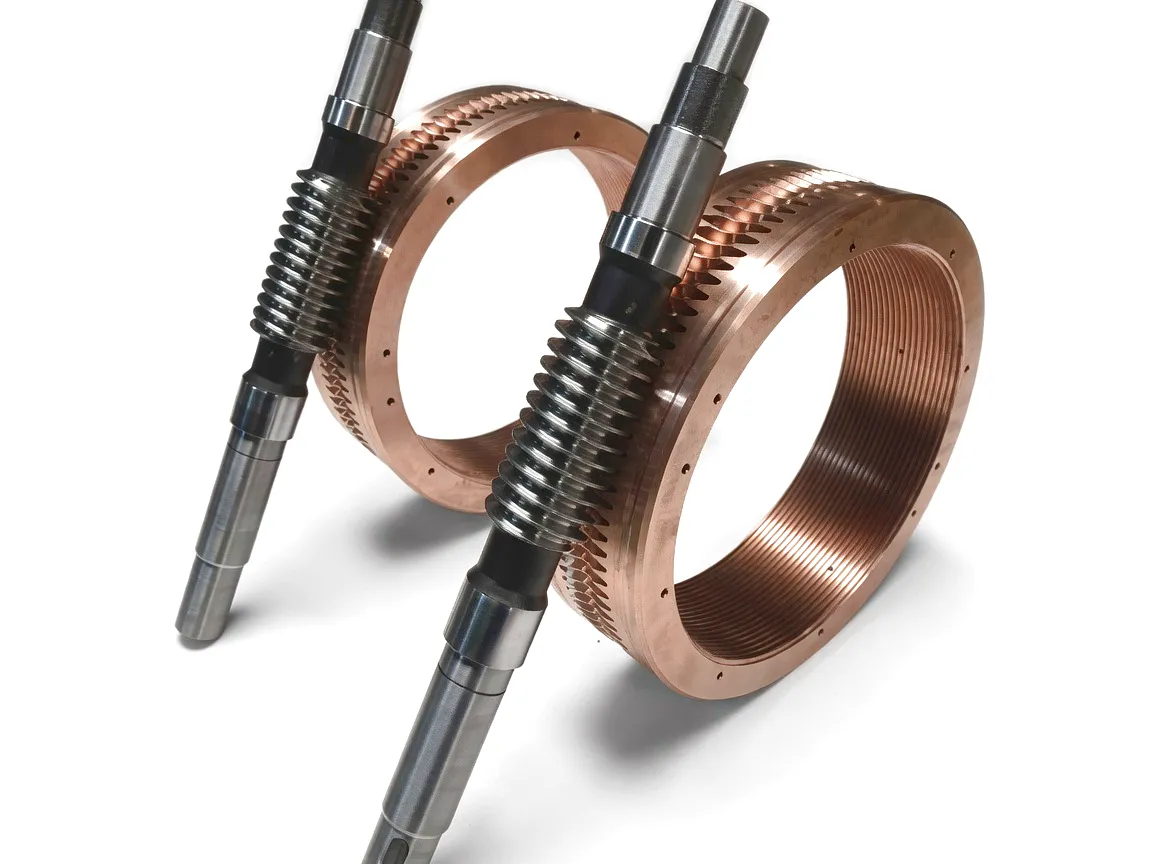
A worm gear shaft is, at its core, a helically threaded shaft that meshes at a 90-degree crossing angle with a worm wheel, achieving large speed-reduction ratios in a single compact stage. The geometry of that thread — its lead angle, pressure angle, tooth profile, and surface finish — dictates everything from transmission efficiency and thermal rise to noise emission and service life. This guide explores every dimension of the worm gear shaft’s engineering logic, the materials science that underpins its manufacture, and the real-world scenarios in which it outperforms planetary and helical alternatives.
How a Worm Gear Shaft Transmits Power — The Engineering Principle
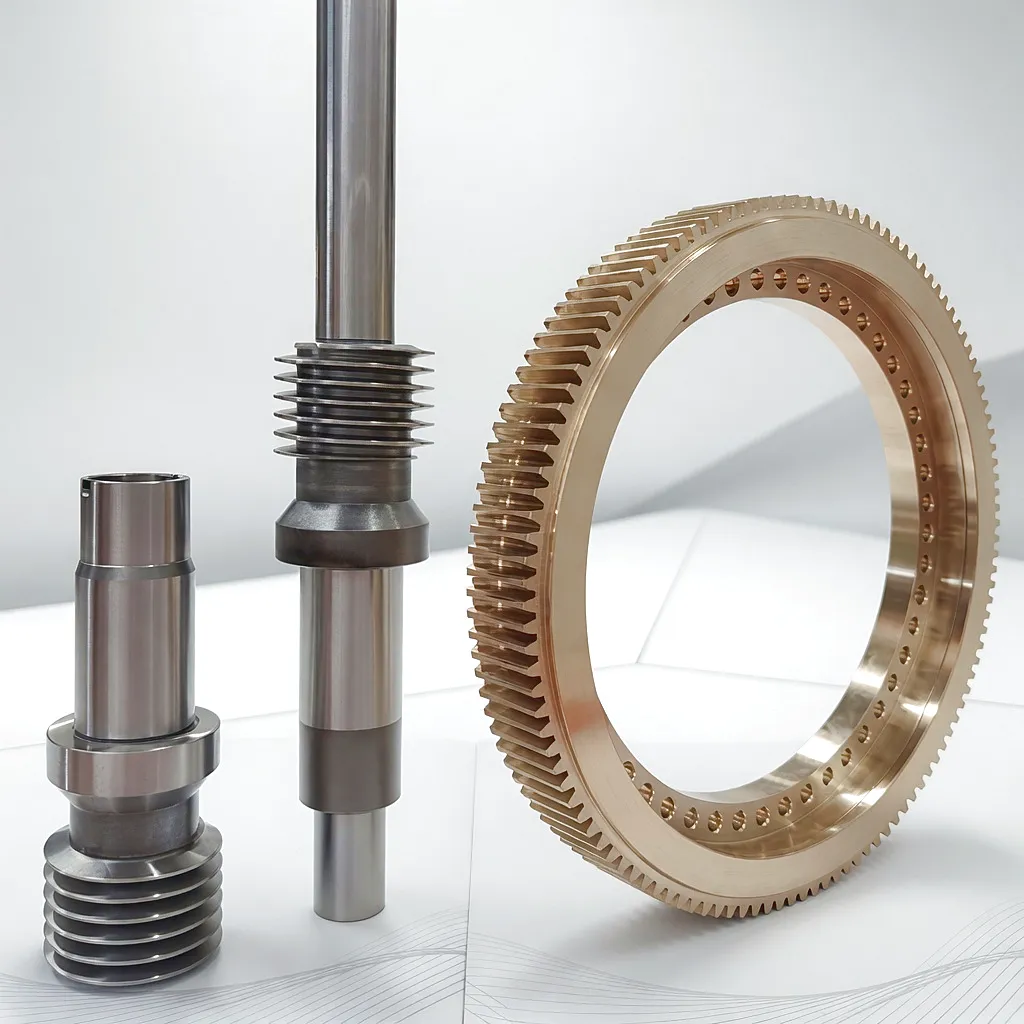
The power-transfer mechanism inside a worm gear assembly begins the moment rotational energy enters the worm gear shaft from the prime mover — typically an electric motor. The shaft’s helical thread, which resembles a screw thread in both appearance and kinematics, engages the teeth of the worm wheel on a sliding-contact basis. Unlike spur-gear or helical-gear pairs, which rely primarily on rolling contact, the worm-and-wheel interface depends heavily on sliding velocity. This sliding action, paradoxically, is what gives the assembly its greatest functional advantages: the ability to achieve velocity ratios from 5:1 up to 100:1 in a single mesh, the inherent self-locking property at lead angles below approximately 6 degrees, and the smooth, near-silent transmission of torque that makes worm drives irreplaceable in public-facing infrastructure such as escalators and lifts.
The geometry of the worm gear shaft thread is characterised by its lead angle, which is the angle between the helix and a plane perpendicular to the shaft axis. At low lead angles the self-locking effect is most pronounced — the gear cannot be back-driven by the output load — but efficiency drops to between 40% and 70%. As the lead angle increases toward 25–35 degrees, efficiency rises toward 90%, self-locking is lost, and the assembly behaves more like a crossed-helical gear pair. Engineers therefore select lead angle deliberately: a passenger escalator drive demands self-locking for safety; an automated packaging conveyor running in continuous reversible mode benefits from higher efficiency and will use a mechanical brake instead. The number of starts on the worm also matters enormously: a single-start worm with a 40-tooth wheel yields a 40:1 ratio, whereas a four-start worm with the same wheel gives only 10:1. Each extra start multiplies efficiency but divides ratio, a fundamental trade-off that competent specification demands.
90°
Shaft Crossing Angle
Standard right-angle configuration enabling compact drive layouts in restricted machine spaces
100:1
Single-Stage Ratio
Maximum ratio achievable in one stage — far exceeding spur or helical pairs requiring cascaded stages
90%
Peak Efficiency
Achieved with multi-start worm thread, bronze wheel and full-film EHL lubrication at rated speed
6°
Self-Lock Lead Angle
Below this lead angle, reverse-drive from output is mechanically impossible — critical for safety-critical lifts
Material Science Behind the Worm Gear Shaft
Why material selection is not cosmetic — it determines thermal budget, fatigue life, and corrosion behaviour under real industrial loading
Case-Hardened Alloy Steel
The worm thread itself is almost universally manufactured from low-alloy steels such as 20CrMnTi, 20Cr2Ni4, or the UK-preferred EN36C case-hardening grade. After rough machining the thread profile is carburised to a case depth of 0.8–1.5 mm and hardened to 58–62 HRC at the surface, while the core remains tough at 35–45 HRC. This combination resists both surface-fatigue pitting and bending fatigue at the thread root. The hardened surface also responds well to grinding and honing, enabling Ra finish values below 0.4 µm which dramatically reduces the friction coefficient at the mesh interface and extends lubricant change intervals in industrial gearboxes running at elevated temperature — a common challenge in Sheffield’s steel-rolling plants where ambient temperatures regularly exceed 40 °C near furnaces.
Phosphor Bronze Wheel Pairing
The worm wheel mating with the hardened steel worm gear shaft is almost always cast or centrifugally cast from tin-phosphor bronze (typically PB2 or the US-equivalent C90700), a material family prized for three distinct properties: its high conformability under load, its ability to embed hard contaminant particles so they cannot score the worm thread, and its excellent thermal conductivity which pulls heat away from the mesh contact zone. Aluminium bronze and nickel-aluminium bronze are used when corrosion resistance in marine or coastal environments takes precedence, as seen in some tidal-energy installations around the Scottish and Welsh coastlines. For very light-duty or food-grade applications, DuPont Delrin (acetal) or nylon 66 wheels are paired with polished stainless-steel worm shafts, eliminating the need for external lubrication entirely.
Stainless & Duplex Grades
In hygiene-critical sectors — pharmaceutical manufacturing in Cambridge’s biotech cluster, food and beverage production across Yorkshire and Lancashire, and chemical processing along the Teesside corridor — the worm gear shaft is specified in 316L stainless steel or super-duplex grade SAF 2507. These materials resist chloride-induced stress corrosion cracking, tolerate steam-cleaning and CIP (clean-in-place) wash-down cycles, and can meet the BS EN 10088 material certification requirements demanded by UK regulatory frameworks. The trade-off is slightly reduced hardness compared to alloy steel, requiring engineers to compensate with more generous safety factors or to accept reduced gear ratios in order to stay within allowable contact stress limits for the given stainless grade.
Core Technical Advantages of the Worm Gear Shaft
Six engineering attributes that keep the worm gear shaft the preferred choice for demanding industrial drives
⚙
Extreme Ratio in One Stage
Achieving ratios up to 100:1 in a single mesh eliminates the cascaded gearbox stages required by helical or spur alternatives. For a conveyor designer in Coventry’s automotive-supply chain this means a dramatically shorter gearbox axle dimension, reduced shaft span, and fewer bearings to align — directly translating into assembly time and lifetime maintenance cost.
🔒
Inherent Self-Locking
When lead angle is kept below 6–8 degrees, the friction between worm thread and wheel tooth physically prevents the output from driving the input in reverse. This passive safety feature removes the need for a separate braking mechanism in escalator drives, lifting platforms, and theatre stage machinery — a significant cost reduction and a simplification of the safety case required by BS EN 115-1 and related UK standards.
🔈
Low Noise and Vibration
The continuous sliding-tooth engagement and the helical geometry of the worm gear shaft thread mean there is no impulsive tooth-entry shock — the cause of the characteristic whine in spur-gear drives. Measured noise levels for well-lubricated worm drives at rated speed are typically 60–70 dB(A), 10–15 dB quieter than equivalent spur-gear stages, a decisive benefit in the post-Brexit regulatory environment where UK PSSR 2000 and noise-at-work regulations increasingly scrutinise industrial-floor dB levels.
📈
Compact Right-Angle Layout
The 90-degree shaft crossing inherent to worm gear transmission enables machine designers to redirect torque around obstacles without the bevel-gear cost penalty. In floor-mounted conveyor frames, in scissor-lift tables, and in the drive stations of escalators installed beneath city-centre pavements in London, Manchester, and Glasgow, this right-angle layout saves valuable headroom and simplifies the mechanical layout, reducing overall drive-station footprint by up to 40% compared with in-line helical reducers of similar torque capacity.
🔧
Smooth Torque Multiplication
Output torque is delivered with minimal ripple compared with the cyclic loading of chain drives or belt transmissions. For precision-positioning applications — robotic welding arms in Wolverhampton’s automotive-body plants, optical-telescope altitude drives at UK observatories, or medical-imaging table actuators — the smooth output torque curve of a properly loaded worm gear shaft eliminates settling oscillation and allows tighter positional tolerances to be maintained under dynamic load changes.
🕑
Long Service Life Under Shock Load
The large contact area between a hardened worm thread and the bronze worm wheel gives the worm gear assembly a much higher shock-load tolerance than a comparable helical stage of the same ratio. When a press-brake in a Birmingham metal-fabrication shop hits a hard spot in the billet, the worm gear shaft absorbs the torque spike with far less risk of tooth chipping than an equivalent involute-tooth stage — a property that substantially reduces unplanned downtime and extends mean-time-between-overhaul intervals beyond the industry standard of 25,000 operating hours.
Product Technical & Performance Parameter Reference
Standard Ever Power worm gear shaft specification range — custom values available on request
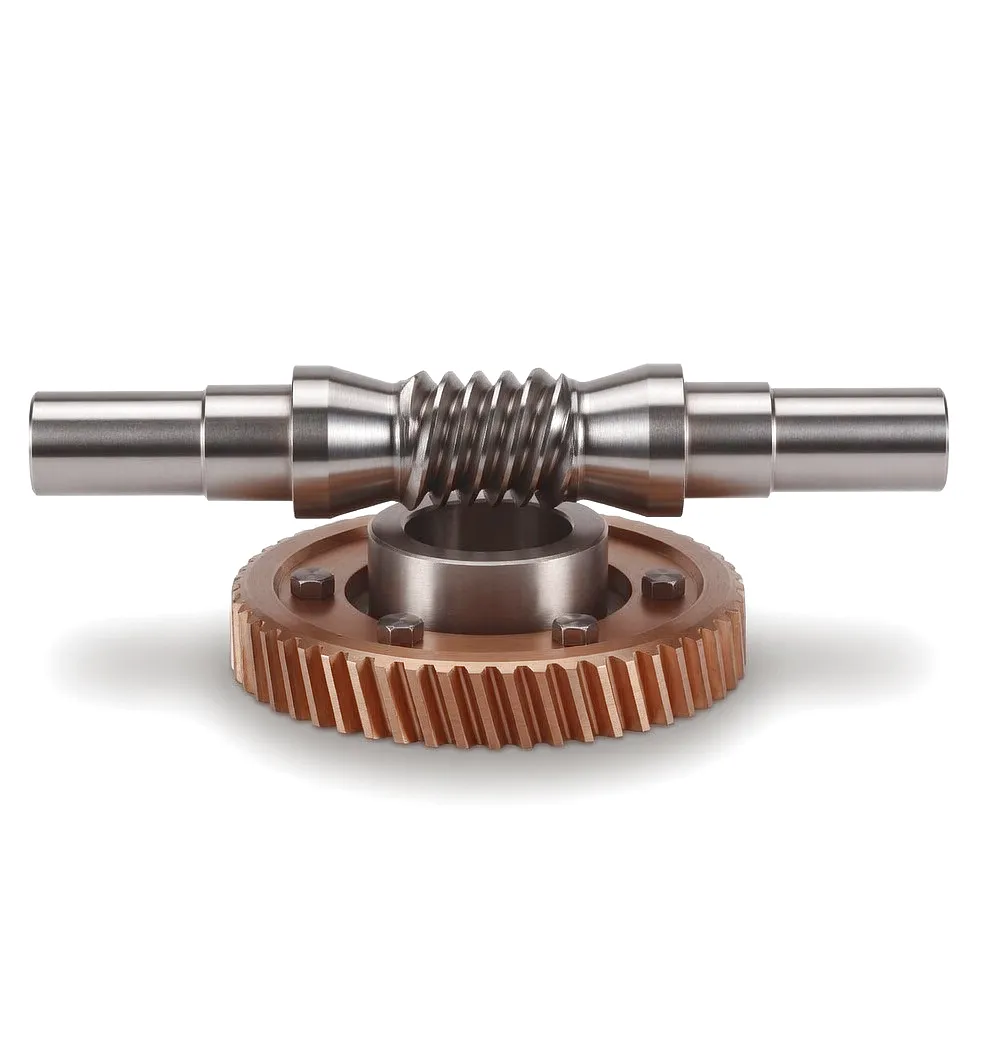
The following parameter table covers the standard production range that Ever Power maintains as in-stock or short-lead items at our manufacturing facility. Beyond these envelope values, our engineering team accepts non-standard requirements including non-integer ratios, extended shaft lengths, hollow-bore configurations, and custom keyway or spline profiles. All shafts are manufactured under a documented ISO 9001:2015 quality management system with full material traceability from certified steel mills, and every precision-ground worm thread is individually inspected on Zeiss CMM equipment before despatch. Lead times to UK destinations via our established freight partnerships are typically 15–25 working days for standard production and 4–6 weeks for fully custom configurations, with express airfreight available for urgent maintenance requirements.
| Parameter | Min | Max | Unit | Notes |
|---|
| Gear Ratio (i) | 5:1 | 100:1 | — | Single-stage; non-standard ratios on request |
| Output Torque | 5 | 20,000 | N·m | Higher torques available with flanged housing variants |
| Input Speed | 10 | 3,600 | rpm | Compatible with IEC and NEMA motor frames |
| Worm Shaft Module (m) | 1 | 16 | mm | ISO 54 module series standard |
| Shaft Diameter (d1) | 12 | 250 | mm | Ground to h6 tolerance as standard |
| Lead Angle (γ) | 3° | 35° | degrees | Low angle = self-locking; high angle = high efficiency |
| Number of Starts | 1 | 6 | — | 1 = max ratio / self-lock; multi-start = high efficiency |
| Transmission Efficiency (η) | 40% | 92% | % | Dependent on lead angle, lubrication, and speed |
| Pressure Angle (α) | 14.5° | 25° | degrees | 20° ZI profile standard per DIN 3975 |
| Surface Hardness (HRC) | 58 | 62 | HRC | Case-hardened carburised alloy steel |
| Surface Roughness (Ra) | — | 0.4 | µm | Thread flanks ground and superfinished |
| Operating Temperature | -30 | +120 | °C | Sealed oil bath; synthetic lubricant extends upper limit |
| Centre Distance (a) | 40 | 400 | mm | Matches standard housing series |
| Shaft Material | 20CrMnTi / EN36C / 316L SS | — | Custom alloy grades and certs available |
Escalator Drive Systems: How the Worm Gear Shaft Powers Vertical Transport
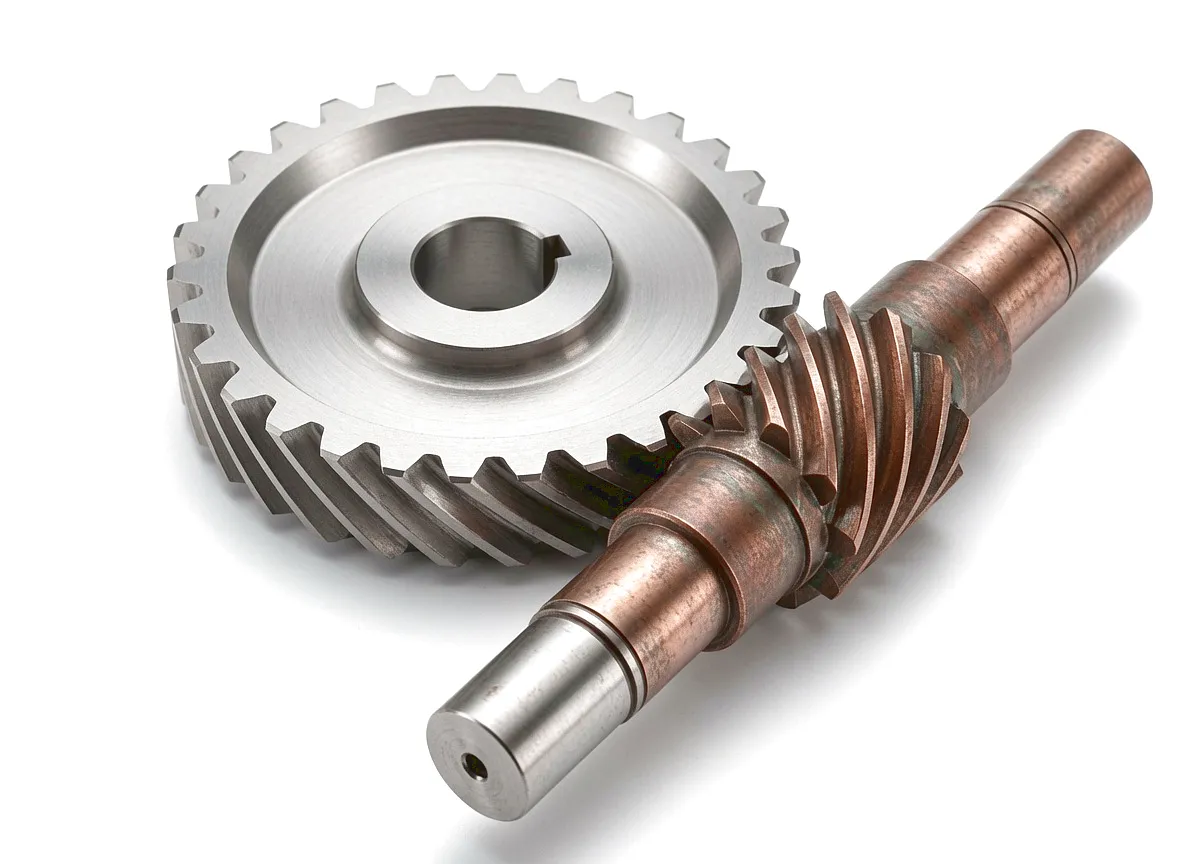
The escalator drive system is one of the most publicly consequential applications of worm gear transmission in the modern built environment. Every escalator running in the London Underground network, in Manchester’s Arndale Centre, or in Birmingham’s Grand Central shopping complex depends on a worm gear reducer — pairing a purpose-designed traction motor with the main drive shaft and step chain — to deliver smooth, controlled movement at standard rated speeds of 0.5 m/s or 0.65 m/s. The worm gear shaft sits at the heart of this reducer, converting the motor’s relatively high rotational speed (typically 1,450–1,500 rpm at 50 Hz mains frequency) down to the slow, high-torque output required to pull the step chain at precisely the right velocity to carry the rated passenger throughput of 7,200 people per hour on a full-width installation.
Motor power ratings for escalator worm reducers are determined by the combination of rising height, step-chain length, and the rated passenger load. In practice, installations in underground stations with moderate rise heights of 6–10 m draw from the 5–11 kW motor bracket, while longer escalators serving deep-level tube platforms — such as those at King’s Cross St Pancras or the refurbished Waterloo station — step up to the 15–22 kW range. The worm gear reducer applied in these escalator drives operates at a transmission ratio of approximately 20:1 to 30:1, chosen to match the output speed to the chain velocity while keeping the motor running at its most efficient load point. This ratio range is precisely where the single-start worm gear shaft excels: it provides self-locking at the friction angles involved, meaning that a power cut cannot cause a loaded escalator to run backwards under passenger weight, satisfying the safety requirements of BS EN 115-1:2017 without any additional mechanical brake in the drivetrain.
20:1–30:1
worm drive ratio
7,200
passengers/hour capacity
Perhaps the most commercially significant advantage of the worm gear reducer in escalator engineering is the geometry of its housing. The compact, square-section gearbox profile that results from a right-angle worm drive arrangement allows the machine room — the drive station containing motor, gearbox, step-chain sprocket, and ancillaries — to be reduced to an extremely small footprint. In underground passenger environments such as the tube, cross-rail stations, and major shopping-centre basements across the UK, headroom and floor space are both severely constrained. A worm gear drive station can be engineered into headroom clearances of as little as 900 mm, compared with the 1,500 mm or more required by equivalent-duty helical-bevel reducers. This headroom saving translates directly into reduced civil-engineering cost and allows escalator installations in locations that would otherwise be structurally infeasible.
Industrial Application Scenarios
Where the worm gear shaft delivers measurable value across UK and global industry sectors

Conveyor & Material Handling
Distribution centres, ports, and automotive-parts logistics across the Midlands and the North rely on worm gear shaft-driven conveyor systems to maintain precise, controllable belt speeds under variable loading. The combination of high reduction ratio and self-locking capability prevents belt rollback on inclined sections — a critical safety requirement for operations handling loads exceeding 500 kg per metre. Amazon’s Rugeley and Sports Direct’s Shirebrook fulfilment sites are typical environments where this attribute directly prevents costly product damage incidents.

Mining & Quarrying
In quarrying operations across Derbyshire and Yorkshire, where jaw crushers, screeners, and extraction conveyors operate in high-vibration, dust-laden environments, the worm gear shaft’s sealed-housing lubrication system and high shock-load tolerance give it a decisive advantage over chain drives. The gearbox’s ability to absorb instantaneous torque spikes — when crusher feed rocks exceed design hardness — prevents drivetrain failures that could idle a quarry face for days.

Renewable Energy
Onshore and offshore wind turbines deployed across Scotland, East Anglia, and Wales use worm gear drives in their nacelle yaw systems to rotate the turbine head into the prevailing wind. The self-locking characteristic of the worm gear shaft prevents the yaw from drifting off-axis in high gusts without consuming continuous electrical braking power — a significant contribution to the UK’s wind-energy efficiency targets. Solar tracking arrays from Cornwall to Northumberland similarly rely on worm gear shafts for east-west panel rotation.

Food, Beverage & Pharma
Stainless-steel worm gear shafts manufactured to IP65 or IP69K ingress-protection standards are the preferred drive element in filling lines, dosing augers, and mixing agitators in Yorkshire’s dairy processing sector and along the pharmaceutical corridor from Cambridge to Harlow. The ability to specify NSF H1 food-grade synthetic lubricants in the gearbox, combined with a smooth sealed exterior that survives high-pressure wash-down, makes the worm gear shaft uniquely suited to GMP-regulated production environments.
Further Established Application Sectors
Theatre & Stage Machinery
Lift & Hoist Equipment
Steel Rolling Mills — Sheffield
Automotive Assembly — Coventry
Robotics & CNC Automation
Packaging Lines
Agricultural Machinery
Marine Winches & Deck Equipment
Ever Power Manufacturing: Precision, Scale, and Customisation
An engineering partner with the capability to deliver exactly what your application demands
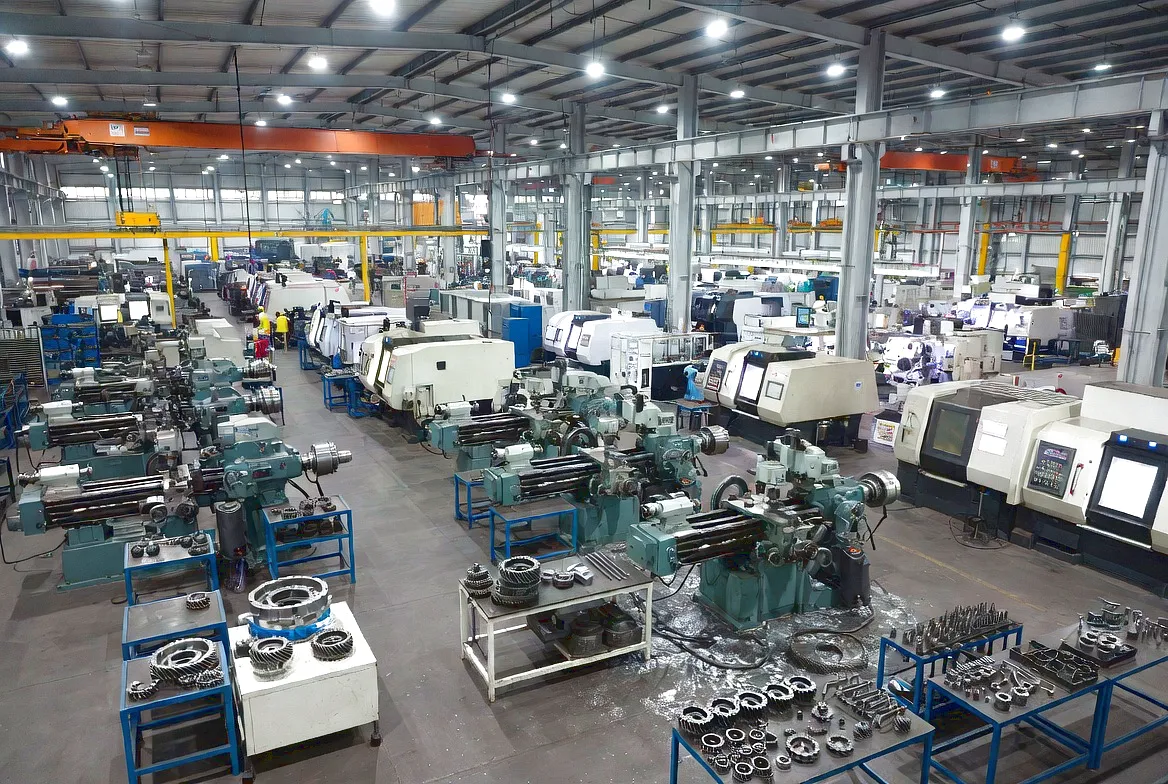
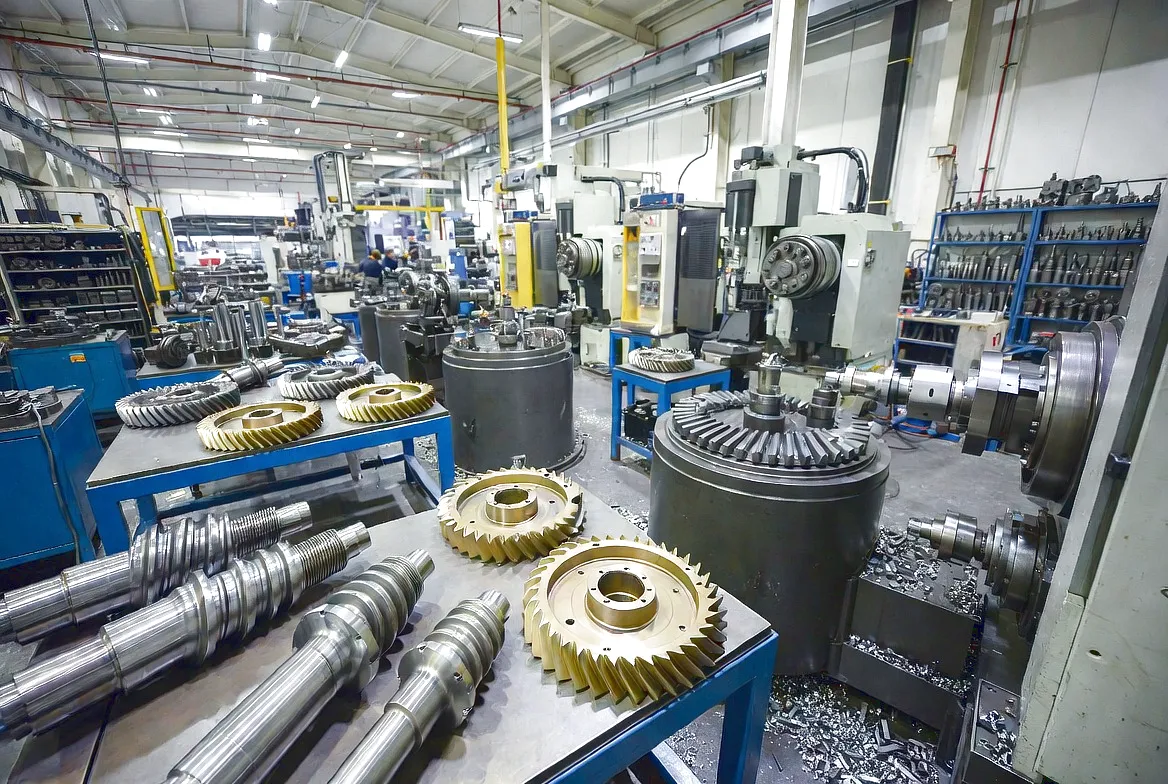
Ever Power has built its reputation in the global mechanical transmission market — and specifically among UK engineering procurement teams — on a single, non-negotiable commitment: the ability to manufacture any worm gear shaft configuration a customer requires, to any standard, in any material grade, with full documentation. Our production facility operates a fleet of CNC thread-whirling centres, multi-axis turning-milling compounds, and dedicated thread-grinding machines that can handle shaft diameters from 12 mm up to 250 mm with sub-micron positional accuracy. Every machine tool is maintained on a calibrated preventive schedule, and all measuring equipment is traceable to national standards through accredited calibration laboratories.
Our customisation capabilities extend far beyond simply cutting a thread to print. Ever Power’s application engineering team works collaboratively with UK customers to optimise worm gear shaft geometry for their specific duty cycle, examining input speed profiles, load-torque curves, ambient temperature ranges, and lubrication access constraints. In many cases this engineering-led approach yields a worm gear shaft design that surpasses the theoretical life prediction of an off-the-shelf alternative by 30–50%, with commensurate reductions in warranty claims and spare-parts inventory. Custom shaft configurations we regularly produce include twin-worm duplex assemblies, shafts with integral spline or multi-key outputs, hollow-bore through-shaft arrangements for cable routing, and shafts integrating encoder-mounting pilots for closed-loop positioning systems. Surface treatment options include hard chrome plating, electroless nickel, TiN PVD coating, and ion nitriding for ultra-hard surface layers above 70 HRC.
ISO 9001
Quality Management Certified
15 Days
Standard UK Lead Time
0.4 µm
Surface Finish Standard
Ready to Source Your Next Worm Gear Shaft from Ever Power?
Send us your drawing, load data, or simply describe your duty cycle. Our application engineers will respond within one working day.
✉ Get a Quote — [email protected]
Customer Success Story
Sheffield, South Yorkshire | Steel Processing & Heavy Industry
Case Study: Reducing Unplanned Downtime by 68% at a Sheffield Steel Strip Processing Line
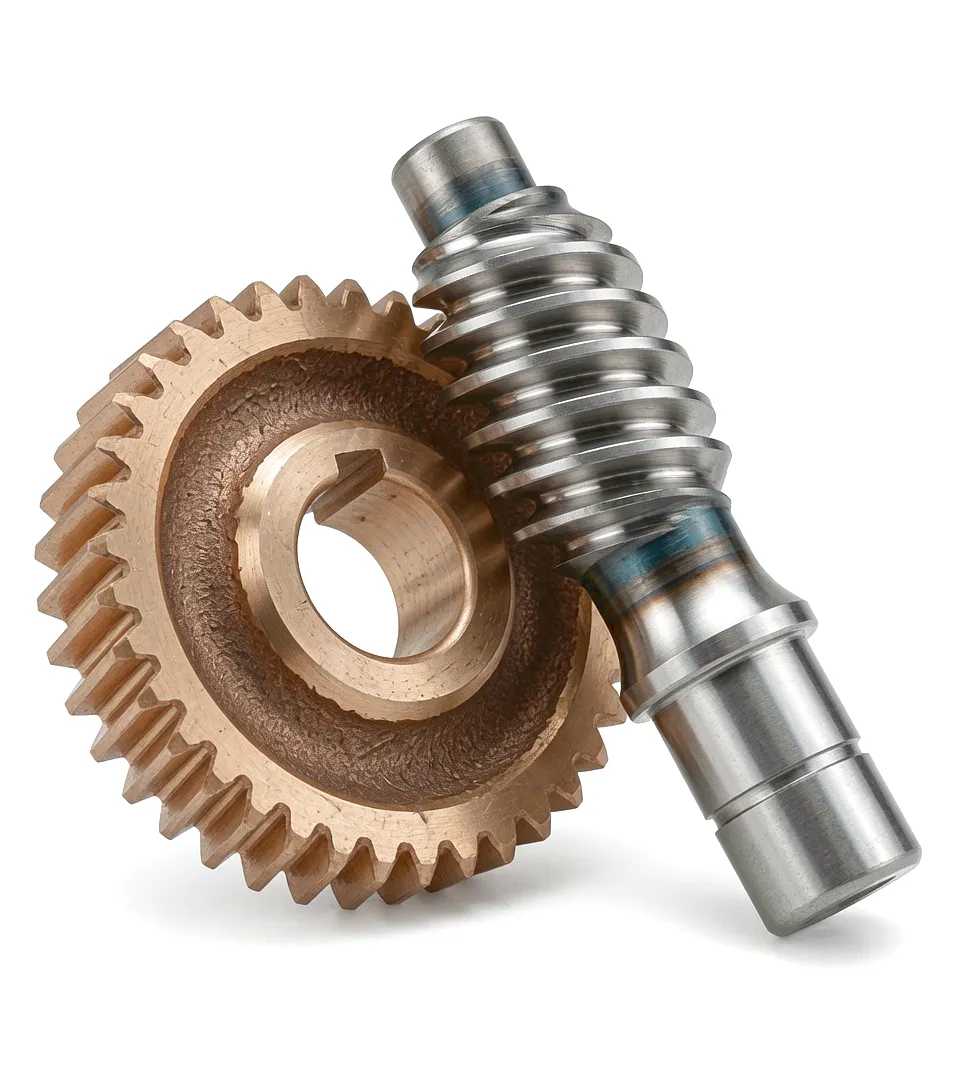
A mid-tier steel strip processing business operating a six-strand continuous annealing and temper-rolling facility on the outskirts of Sheffield had, for several years, been experiencing premature failure of the worm gear assemblies driving its coil-handling mandrels. The failures — predominantly through-thickness pitting fatigue on the worm wheel — were occurring at an average interval of 9,000 operating hours, well short of the 20,000-hour design target. Each failure event required an unscheduled six-hour line shutdown, crane access to extract the damaged gearbox, and an average spare-parts cost of £3,200 per event. Over a 24-month operating period the company had suffered eleven such events, accumulating a total loss — direct repair costs plus lost production at £1,800 per hour — approaching £430,000.
The client’s maintenance manager contacted Ever Power through a recommendation from a sister plant in Rotherham that had already switched its conveyor worm gear shafts to Ever Power supply. After receiving the original OEM drawings and two years of failure-analysis data, Ever Power’s application engineering team identified two root causes: the original worm gear shaft material specification (C45 through-hardened to 280 HB) was insufficient for the elevated operating temperature of 75–80 °C created by the annealing furnace radiation, and the bronze wheel alloy selected by the original manufacturer had too low a tin content to resist the sub-surface shear stress at the operating contact stress of 380 MPa.
Ever Power proposed a redesigned worm gear shaft in 20CrMnTi case-hardened and ground to 60 HRC, paired with a centrifugally-cast PB2 phosphor-bronze wheel with minimum 12% tin content. The thread geometry was also revised, raising the pressure angle from 14.5° to 20° to reduce Hertzian contact stress at the pitch line by approximately 18% without changing the installed centre distance. First delivery of the custom worm gear shaft sets reached the Sheffield site within 21 working days, including full CMM inspection reports and material certificates traceable to the melting heat. The plant installed the upgraded components during a planned maintenance window and continued in service. At the 12-month review point, zero worm gear shaft failures had been recorded. The client formally re-ordered a complete strategic spare set of four units and entered a preferred-supplier framework agreement with Ever Power covering all six strands of the processing line.
★★★★★
“We ran our previous supplier’s worm shaft for less than 9,000 hours before failure. Ever Power’s redesigned shaft has now passed 13,000 hours on the most demanding mandrel position with no measurable wear on the flanks. The material traceability documentation also satisfied our ISO 50001 energy audit requirements without any additional paperwork from us.”
— Mark T., Maintenance Engineering Manager, Steel Processing Ltd, Sheffield
★★★★★
“The geometry change to 20-degree pressure angle was something none of our UK-based gearbox suppliers had even suggested in three years of failure investigations. Ever Power’s team picked it up from our duty cycle data on the first call. The new worm gear shaft set arrived dimensionally identical to the OEM in all interface dimensions — a straight drop-in replacement with zero machine modifications required.”
— Sarah L., Procurement Director, Midlands Industrial Components, Birmingham
★★★★★
“We specified Ever Power worm gear shafts for the yaw drive on our onshore wind repowering project in Dumfries and Galloway. The hollow-bore variant with encoder pilot saved us approximately four hours of on-tower assembly time per turbine across the 18-unit site. Delivery of all 36 units (two per turbine) arrived in one consolidated shipment to our Carlisle logistics hub, exactly as promised in the quotation.”
— James F., Project Engineer, Northern Wind Developments, Carlisle
How to Select the Right Worm Gear Shaft for Your Application
A practical checklist from Ever Power’s application engineering team
01
Define Output Torque & Speed
Calculate peak and continuous output torque (N·m), required output speed (rpm), and the required ratio. Apply a service factor of 1.5–2.5 depending on daily running hours and shock-load classification per AGMA 2001 or BS ISO 6336.
02
Decide on Self-Locking Requirement
If the application must hold position under gravity or regenerative load without a brake, specify lead angle below 6°. If efficiency is the priority and a separate brake is acceptable, use multi-start thread geometry for lead angles of 20°–35°.
03
Select Material Grade
Standard duty: 20CrMnTi carburised and ground. Corrosive/hygienic: 316L stainless. High-temperature: EN40B nitrided. Food/pharma: 303 stainless with NSF-H1 lubrication. Confirm material certificates are provided before acceptance.
04
Specify Housing & Mounting
Confirm input/output shaft positions (horizontal, vertical, or reversed input), housing mounting configuration (foot, flange, shaft mount), and IP rating requirements. Worm-below-shaft oil-bath mounting is preferred for lubrication, but worm-above is possible with forced lubrication.
Frequently Asked Questions
Real questions from engineers and procurement teams across the UK — answered by Ever Power’s technical specialists
How do I choose a worm gear shaft supplier in the UK that can handle custom specifications and deliver within 3–4 weeks?
▼
When evaluating a UK-compatible worm gear shaft supplier for custom or non-standard requirements, the four factors that matter most in practice are manufacturing capability breadth, quality traceability, lead-time transparency, and technical pre-sales support. Suppliers manufacturing in-house — rather than trading OEM products — can generally turn around bespoke worm gear shaft sets in 15–25 working days for alloy-steel grades, provided your drawing package is complete at the point of order. Always request material certificates at order placement, confirm the supplier operates under ISO 9001:2015, and ask specifically whether CMM inspection data is included with despatch. Ever Power satisfies all four criteria and ships regularly to UK customers via bonded freight services from our manufacturing facility, with typical clearance through UK customs taking 2–3 working days on standard commercial invoices.
What is the typical price range for a custom worm gear shaft, and what factors affect the cost of my quote?
▼
The cost of a worm gear shaft is driven primarily by shaft diameter and length (which determine raw material weight and CNC machine time), material grade (standard alloy steel versus stainless or nitrided grades carry a 30–80% material premium), thread-grinding requirement (adds approximately 25–40% to machining cost but is non-negotiable for service lives above 15,000 hours), and quantity. Small-diameter shafts (20–50 mm) in alloy steel at quantities of 10–50 pieces typically fall in the £80–£350 per unit range ex-works. Larger diameters (100–200 mm) in custom alloy grades with full CMM documentation can reach £800–£3,500 per unit. Volume pricing at 100+ pieces per order typically yields 20–35% reductions. Request a quotation from [email protected] with your drawing or basic duty parameters for a specific price within 24 hours.
Which industries in Birmingham and Sheffield rely most heavily on worm gear shaft drives, and why do they keep choosing this technology over helical gearboxes?
▼
In Birmingham, the predominant sectors are precision metal forming, automotive-component supply (particularly press-brake and stamping-line drives), and the pharmaceutical packaging operations concentrated in the B7–B11 postcode area. In Sheffield, steel strip processing, heavy forging, and ceramics manufacturing are the major consumers. These sectors favour the worm gear shaft over helical alternatives for two consistent reasons: the availability of a self-locking mechanism that acts as a passive brake on loaded vertical slides and hoist equipment, removing a component from the safety case; and the compactness of the right-angle drive that allows retro-fit into existing machine envelope constraints. Helical reducers typically require larger centre distances and longer axial spans for equivalent ratio, which cannot be accommodated without machine frame modification in established production lines.
How long does a worm gear shaft typically last in a continuous conveyor application running 24 hours a day, and what maintenance will I need?
▼
A correctly specified, properly lubricated worm gear shaft in a continuous 24/7 conveyor duty should reach at least 25,000–30,000 operating hours before the thread flanks show measurable wear requiring attention — equivalent to approximately 3 years of uninterrupted operation. The primary maintenance tasks are oil-level checks and sampling at 2,000-hour intervals, a full oil change at 5,000 hours (or annually, whichever comes first), seal replacement at 10,000 hours, and bearing inspection at 15,000 hours. The most common cause of premature failure in field units is contaminated lubricant — water ingress through a failing lip seal causes accelerated flank corrosion on the hardened worm thread, reducing life to 6,000–8,000 hours. This is why Ever Power routinely recommends upgrading input and output shaft seals to labyrinth-type seals on gearboxes exposed to wash-down, condensation, or outdoor conditions.
Where can I find a reliable worm gear shaft supplier who can provide traceable material certificates and quality documentation for UK engineering audits?
▼
Full material traceability for worm gear shaft components supplied to UK industrial customers is not a premium add-on — it is a standard deliverable from Ever Power with every order. Our documentation package includes the steel mill certificate (EN 10204 Type 3.1 as standard, Type 3.2 on request) traceable to the specific heat number, heat treatment records with furnace charts and hardness verification, CMM inspection report with actual measurements on all critical dimensions, surface roughness measurement trace, and our own Declaration of Conformance. This documentation package satisfies the requirements of ISO 9001 quality management audits, PSSR 2000 written scheme requirements, and the supply-chain assurance programmes operated by major UK tier-one manufacturers in the defence, nuclear, and process industries. Contact [email protected] to request a sample documentation package before placing your order.
What is the best way to specify a worm gear shaft for an escalator drive station that needs to meet UK safety standards and fit within a restricted machine-room envelope?
▼
Escalator worm gear shaft specification for UK installations must satisfy BS EN 115-1:2017 requirements covering minimum braking torque margin, self-locking assurance across the operating temperature range (particularly important for outdoor or semi-outdoor locations such as superstore trolley ramps in Scotland where ambient temperature can reach -10 °C), and dynamic load testing. The recommended approach is to start from the step-chain pull force and the chain sprocket radius to establish actual output torque demand, then work backwards through the worm gear ratio (typically 20:1–30:1 for standard escalator speeds) to arrive at worm gear shaft input speed and torque. A service factor of 2.0 is appropriate for escalator duty given the potential for asymmetric loading during rush-hour crowd surges. For restricted machine-room envelopes, specify the minimum centre-distance gearbox series compatible with the torque rating — Ever Power can advise on the exact cross-over point between adjacent frame sizes to extract the maximum duty from the smallest housing format.
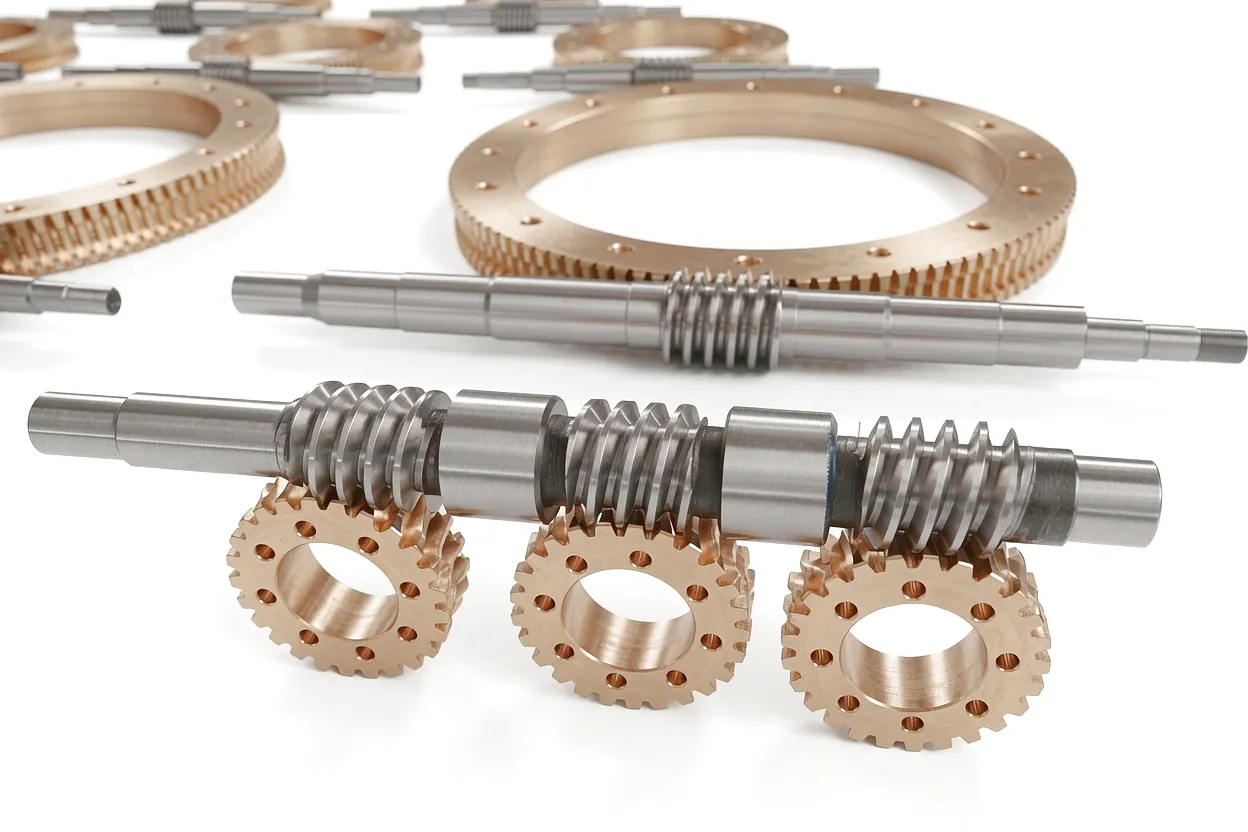
Talk to an Ever Power Worm Gear Shaft Specialist
Whether you need a standard replacement, a fully customised shaft to your drawing, or expert guidance on your worm gear selection, our UK-experienced technical team is ready to assist. Send your enquiry to receive a detailed technical response and competitive quote.
📧 Get a Quote — [email protected]
edit by gzl